 blog
Scalp Psoriasis vs Seborrheic Dermatitis: Key Symptom Differences
Table of Contents
- Understanding Scalp Psoriasis and Seborrheic Dermatitis
- Scalp Psoriasis Symptoms: What to Look For
- Seborrheic Dermatitis Scalp Symptoms Explained
- Side-by-Side: Key Symptom Differences
- Sebopsoriasis: When Both Conditions Overlap
- How to Tell Scalp Psoriasis From Dandruff and Other Conditions
- When to Seek Professional Evaluation
- Frequently Asked Questions
Last Updated: October 10, 2026
Understanding Scalp Psoriasis and Seborrheic Dermatitis
When comparing scalp psoriasis vs seborrheic dermatitis, these two distinct chronic scalp conditions often get confused because they share some similarities. Both cause scaling, redness, and discomfort on the scalp. But they have different underlying causes, different patterns of symptoms, and different treatment approaches.
Scalp psoriasis is an autoimmune condition where your immune system attacks healthy skin cells, causing inflammation and rapid cell turnover. Seborrheic dermatitis is an inflammatory condition linked to yeast overgrowth and a disrupted scalp microbiome (Seborrheic Dermatitis Revisited). Both are chronic, but the mechanisms differ fundamentally.
Treating one condition as if it were the other leads to frustration and wasted time. A medicated shampoo effective for seborrheic dermatitis may not help scalp psoriasis. Correct diagnosis is essential for effective treatment.
Scalp Psoriasis Symptoms: What to Look For
Scalp psoriasis presents with thick, well-defined patches of inflammation and scaling, typically at the hairline, behind the ears, and along the center part line. Symptom appearance varies significantly across skin tones, affecting accurate self-recognition.
Scale Appearance and Texture
Psoriasis scales are thick, silvery-white, and tightly adherent to the scalp. They don't brush away easily and accumulate into visible plaques. Unlike dandruff flakes, which are tiny and loosely attached, psoriasis scales form substantial, dry layers.
Scale appearance varies by skin tone: on lighter skin, scales appear bright silvery-white; on medium skin, white or gray; on darker skin, gray, white, or brownish. Regardless of tone, the key feature is thickness and adherence, psoriasis scales cling firmly and don't brush away easily, unlike dandruff or seborrheic dermatitis flakes.
Redness and Inflammation
Underneath the scales is significant inflammation. On lighter skin, it appears fiery red or pink; on medium skin, deeper pink or salmon; on darker skin, darker patches or purple tones. Warmth, swelling, and tenderness are reliable indicators across all skin tones. The inflammation is intense and persistent, often extending beyond visible scales and spreading during flares.
Itching and Discomfort
Itching ranges from mild to severe and often worsens at night or during stress. Scratching can trigger the Koebner response, where new psoriasis patches develop at injury sites, creating a difficult cycle. Beyond itching, people report soreness, tenderness, and burning sensations.
Hair and Scalp Complications
Scalp psoriasis can cause temporary hair shedding (usually reversible once inflammation subsides), scratching-related damage, scale accumulation that mats hair, and increased sensitivity to harsh products. Unlike scarring alopecia, psoriasis-related shedding reverses with effective treatment, with regrowth resuming within 3-6 months.
Seborrheic Dermatitis Scalp Symptoms Explained
Seborrheic dermatitis thrives in areas with high sebum production. It's an inflammatory response to yeast and an imbalanced scalp microbiome, not an autoimmune attack.
Greasy, Yellowish Scales
Seborrheic dermatitis scales are greasy, oily, and yellowish or brownish, clumping in a waxy mass. They brush away more easily than psoriasis scales but quickly return. The scalp feels slick and greasy even after washing, and the scales often have a distinct unpleasant smell. They're smaller and more loosely attached than psoriasis plaques.
Oiliness and Inflammation
Seborrheic dermatitis involves excess sebum production, creating an ideal environment for yeast growth. Inflammation is present but typically less intense than psoriasis, with lighter redness. Oiliness often extends to the face, especially around eyebrows, nose, and forehead. The condition flares with stress, cold weather, or humidity changes, and overwashing can worsen it by triggering more sebum production.
Affected Areas Beyond the Scalp
Seborrheic dermatitis commonly appears on eyebrows, nose, behind ears, upper chest, upper back, and groin, areas with high sebaceous gland activity. If symptoms appear only on the scalp, psoriasis is more likely. If similar symptoms appear on the face, ears, or chest, seborrheic dermatitis is more probable.
Side-by-Side: Key Symptom Differences
The clearest way to distinguish these conditions is to compare them directly. Here's what sets them apart:
| Symptom | Scalp Psoriasis | Seborrheic Dermatitis |
|---|---|---|
| Scale color | Silvery-white | Yellowish or brownish |
| Scale texture | Thick, dry, tightly adherent | Greasy, oily, loosely attached |
| Underlying redness | Fiery red, intense | Light pink or salmon |
| Scalp feel | Dry, rough | Oily, slick |
| Itching intensity | Often severe | Mild to moderate |
| Affected areas beyond scalp | Rare | Common (face, ears, chest) |
| Triggers | Stress, injury, cold weather | Stress, humidity, overwashing |
| Scale odor | Minimal | Often present and unpleasant |
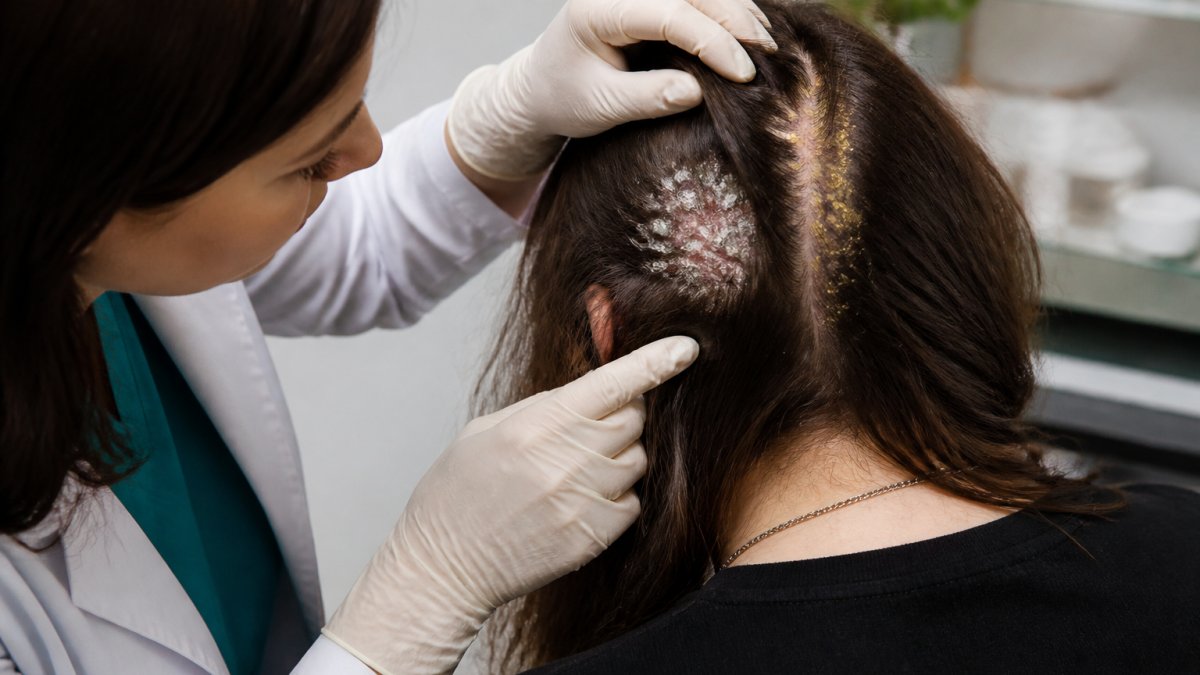
The visual difference is often the most telling sign. If someone shows you a photo of their scalp, you can usually identify which condition it is based on the scale appearance alone. Psoriasis scales are unmistakably thick and white. Seborrheic dermatitis scales are unmistakably greasy and yellow.
Sebopsoriasis: When Both Conditions Overlap
Sometimes the distinction isn't clean. Some people develop sebopsoriasis, a condition where features of both scalp psoriasis and seborrheic dermatitis appear together. This overlap happens because both conditions can coexist on the same scalp.
Sebopsoriasis presents with characteristics of both:
- Thick scaling with some greasy components
- Significant inflammation with moderate-to-intense redness
- Itching that varies in intensity
- Involvement of multiple scalp areas and sometimes facial areas too
The overlap occurs because the underlying causes can reinforce each other. A disrupted scalp barrier from psoriasis makes the scalp more vulnerable to yeast overgrowth. Meanwhile, the inflammatory environment created by seborrheic dermatitis can trigger or worsen psoriasis in susceptible people.
Treating sebopsoriasis requires addressing both components. Standard seborrheic dermatitis treatments alone won't resolve the psoriasis component. Similarly, psoriasis treatments might not fully address the oily, yeast-related symptoms. This is where a holistic approach becomes essential.
How to Tell Scalp Psoriasis From Dandruff and Other Conditions
Many people initially mistake both scalp psoriasis and seborrheic dermatitis for simple dandruff. Dandruff is actually a mild form of seborrheic dermatitis, but the distinction matters for treatment.
True dandruff involves minor flaking and mild itching. The scales are small and loosely attached. Your scalp might be slightly oily or slightly dry, but there's minimal inflammation. Over-the-counter anti-dandruff shampoos often resolve it.
Scalp psoriasis, by contrast, doesn't respond to standard dandruff shampoos. The condition is more severe, with thicker scaling and deeper inflammation.
Start Your Hair & Scalp Healing Journey →
Seborrheic dermatitis sits between simple dandruff and severe conditions. It responds partially to some anti-dandruff treatments, but often requires stronger interventions.
Other scalp conditions that can mimic these include:
- Contact dermatitis from hair products or dyes
- Fungal infections like tinea capitis (ringworm)
- Folliculitis from bacterial infection
- Lichen planus, which causes scarring inflammation
The key difference: psoriasis and seborrheic dermatitis are chronic conditions that persist over weeks and months. They don't resolve with a single treatment. They recur predictably.
When to Seek Professional Evaluation
Accurate diagnosis is essential because scalp psoriasis and seborrheic dermatitis require different treatment approaches, and the two can coexist or mimic one another. Understanding when to seek professional evaluation, and what to expect during that evaluation, helps you move forward with confidence.
Red Flags That Require Immediate Professional Assessment
You should see a healthcare provider if your scalp symptoms persist for more than two weeks despite using over-the-counter treatments. Professional evaluation becomes especially important if:
- Your scalp symptoms are spreading or worsening over days or weeks
- You're experiencing significant hair loss alongside the scaling and inflammation (more than 50-100 hairs per day in the shower)
- The itching is severe enough to disrupt sleep, work, or daily life, or if scratching has caused visible bleeding or open sores
- You've tried multiple treatments (including anti-dandruff shampoos or over-the-counter hydrocortisone) without improvement after 3-4 weeks
- You have scaling and inflammation on other parts of your body simultaneously, face, ears, chest, or skin folds (a pattern that strongly suggests seborrheic dermatitis)
- Your scalp shows signs of infection: oozing, crusting, warmth, swelling, or pus-filled bumps
- You have a family history of psoriasis, autoimmune conditions, or severe seborrheic dermatitis
A Safe Self-Check Framework
Before scheduling an appointment, you can gather information to share with your provider. This self-assessment doesn't replace professional diagnosis but helps you recognize patterns:
Scale characteristics: Examine a small area of your scalp. Are the scales thick and silvery-white, or greasy and yellowish? Do they cling tightly or brush away easily? Take a photo in natural light for your provider.
Inflammation pattern: Look at the color and texture of the skin beneath the scales. Is it fiery red or light pink? Does the redness extend beyond the visible scales?
Distribution: Where on your scalp do symptoms appear? Hairline, center part, behind ears, or scattered throughout? Do you have similar symptoms on your face, eyebrows, or ears?
Itch and triggers: Rate your itching on a scale of 1-10. Does it worsen at specific times (night, stress, after washing)? Does scratching seem to create new patches?
Response to products: Have you used anti-dandruff shampoos, corticosteroid creams, or other treatments? What was the result? Did symptoms improve, stay the same, or worsen?
Timeline: When did symptoms start? Have they been constant or do they come and go? What was happening in your life when they began (stress, new products, seasonal change, illness)?
Diagnostic Uncertainty and Overlap
One reason professional evaluation matters: scalp psoriasis and seborrheic dermatitis can coexist in the same person, a condition sometimes called sebopsoriasis. Additionally, the two conditions can appear similar enough that even experienced practitioners may need to observe your scalp over time or consider your response to initial treatment before confirming a diagnosis.
Your provider may ask about:
- Family history of psoriasis or autoimmune conditions
- Whether symptoms improve or worsen with specific triggers (stress, cold weather, certain products)
- Whether you have psoriasis or related autoimmune conditions elsewhere on your body
- Your scalp care routine and any recent changes to hair products
In some cases, a dermatologist may take a small sample of scalp tissue (biopsy) for microscopic examination to confirm the diagnosis, particularly if the presentation is atypical or if both conditions appear to be present.
What to Expect During Professional Evaluation
A dermatologist will typically examine your scalp under good lighting, sometimes using a dermatoscope (a handheld magnifying tool) to see fine details. They'll ask about symptom onset, severity, triggers, and any treatments you've tried. They may also examine other areas of your skin and ask about your medical and family history.
If diagnosis remains unclear after visual inspection, a biopsy, a quick, minimally uncomfortable procedure, can provide definitive confirmation. The sample is sent to a laboratory where a pathologist examines it under a microscope to identify the specific inflammatory pattern and cell characteristics unique to each condition.
Why Diagnosis Matters for Treatment
Misdiagnosis leads to wasted time and money on ineffective treatments. Antifungal shampoos and products designed for seborrheic dermatitis won't resolve scalp psoriasis because they don't address the autoimmune component. Conversely, topical corticosteroids alone may not fully resolve seborrheic dermatitis if yeast overgrowth is driving the inflammation. A correct diagnosis ensures your treatment plan targets the actual cause, not just the symptoms.
Frequently Asked Questions
What are the key differences between seborrheic dermatitis and scalp psoriasis?
Scalp psoriasis produces thick, silvery-white, dry scales with well-defined red borders and typically affects the scalp, hairline, and behind the ears. Seborrheic dermatitis causes greasy, yellowish scales with less distinct borders and tends to appear in oily areas like the scalp, eyebrows, and nasolabial folds. Seborrheic dermatitis often feels more oily, while scalp psoriasis feels drier. The conditions can coexist in some people, a presentation sometimes called sebopsoriasis.
Can someone have scalp psoriasis and seborrheic dermatitis at the same time?
Yes, some people develop both conditions simultaneously or in sequence, a phenomenon sometimes referred to as sebopsoriasis. When both are present, the scalp may show characteristics of each: patches with thick, silvery scales alongside areas of greasy, yellowish flaking. This overlap can make self-diagnosis difficult and increases the importance of professional evaluation to identify which condition is dominant and how to address both effectively.
How to tell scalp psoriasis from dandruff?
Dandruff is mild flaking caused by normal skin cell turnover or a fungal response, producing small, loose flakes without significant redness or thick plaques. Scalp psoriasis causes larger, adherent scales that are thicker and more silvery-white, with prominent red, inflamed patches beneath them and well-defined borders. Scalp psoriasis also typically causes more intense itching and soreness. If flaking persists beyond a few weeks, worsens, or is accompanied by significant redness and discomfort, professional evaluation is warranted.
When should I see a dermatologist about an itchy, flaky scalp?
Seek professional evaluation if scalp flaking, redness, or itching persists for more than two to three weeks, spreads to other areas, causes significant discomfort or hair shedding, or does not improve with over-the-counter treatments. A dermatologist can perform clinical examination and dermoscopic evaluation to distinguish between scalp psoriasis, seborrheic dermatitis, and other conditions, then recommend appropriate treatment based on your specific presentation and skin tone.