 blog
Are Herbal Rinses Effective for Itchy Scalp Relief?
Last Updated: October 30, 2026
Quick Summary
Herbal rinses can soothe mild itching, redness, and dryness, but they do not treat the underlying cause. Chamomile, calendula, nettle, and rosemary are gentle options when used with care. For dandruff or seborrheic dermatitis, a rinse works best alongside a medicated shampoo, and persistent symptoms need medical assessment.
- Two tablespoons of dried herb steeped in two cups of water for 15 to 20 minutes.
- Cool the rinse to lukewarm before applying it, since hot liquid can scald and worsen itch.
- Refrigerate fresh rinses and use within 48 hours; discard if sour, cloudy, or particled.
- Limit essential oil to 2 to 3 drops per cup, dispersed in carrier oil before mixing.
- Give a rinse plus medicated shampoo routine four to six weeks before judging results.
Table of Contents
- What Causes an Itchy Scalp and Where Herbal Rinses Fit
- The Herbal Rinses That Are Most Commonly Recommended
- How to Make Herbal Hair Rinses at Home
- Tea Rinse for Itchy Scalp: Measurements and Application
- Herbal Rinse for Dandruff and Seborrheic Symptoms
- Dry Scalp Home Remedies Beyond the Rinse
- Patch Testing, Irritation Risks, and When to See a Doctor
- Booking a Scalp Consultation for Persistent Itch
- Frequently Asked Questions
What Causes an Itchy Scalp and Where Herbal Rinses Fit
Herbal rinses for itchy scalp relief are a popular home option, but they work best when you know what is causing the itch. Many women try rinse after rinse without knowing the root issue. A scalp itch usually has a cause, and the cause decides what helps.
An itchy scalp is a symptom, not a diagnosis. Dryness, irritation, product buildup, fungal overgrowth, and skin conditions such as seborrheic dermatitis or psoriasis can all produce it. Herbal rinses may soothe mild, everyday irritation. They do not treat every cause.
Dryness, Irritation, and Dandruff Explained
Dry scalp often shows up as small, fine flakes and tightness. Irritation tends to come with redness, burning, or sensitivity after certain products. Dandruff is a common form of flaking that can be linked to yeast-like organisms on the scalp.
- Dry scalp: fine white flakes, tightness, itch that worsens in winter
- Irritation: redness, stinging, itch after new products
- Dandruff: oily or greasy flakes, itch that comes and goes
- Seborrheic dermatitis: red, greasy, scaly patches that may need medical care
The Herbal Rinses That Are Most Commonly Recommended
Many people reach for a few familiar plant ingredients. Their reputation comes largely from tradition and everyday use, and the scientific evidence for each is often limited. Treat them as gentle, optional support rather than proven treatments.
Chamomile and Calendula for Redness
Chamomile is commonly used to calm mild redness and irritation. Calendula is often added for its soothing feel. Both are gentle, and many people tolerate them well, but some people are allergic to plants in the daisy family.
Tea Tree and Rosemary for Flaking
Tea tree oil is strong and can irritate, so it should always be diluted. Before adding it to any rinse, check whether salicylic acid is safe for sensitive scalps.
How to Make Herbal Hair Rinses at Home
A good herbal rinse is mostly water, a measured amount of dried herb, and a clean application method. The recipe matters less than the ratios, the steep time, and how you store what is left over. Below are three reproducible starting points, followed by the rules that apply to all of them.
The Base Method (Works for Most Herbs)
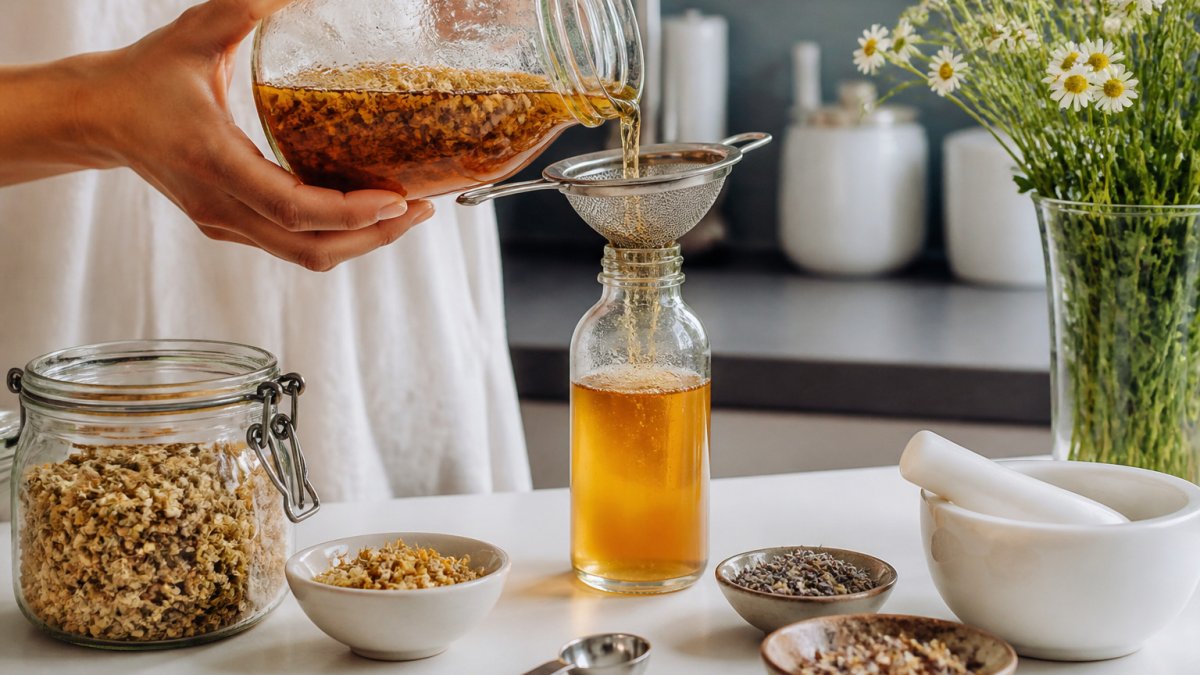
- Bring 2 cups of filtered water to a boil, then remove from heat.
- Add 2 tablespoons of dried herb (or 4 tablespoons of fresh herb) to the hot water.
- Cover and steep for 15 to 20 minutes. Covering keeps volatile oils from escaping.
- Strain through a fine-mesh sieve or cheesecloth into a clean glass jar.
- Let the liquid cool to lukewarm before it touches your scalp.
- After shampooing, pour slowly over the scalp, working section by section. Massage for about one minute.
- Leave on for 3 to 5 minutes, then rinse with cool or lukewarm water.
That base yields roughly 1.5 cups of usable rinse, which is enough for one application on shoulder-length hair. Double the recipe for longer or thicker hair.
Three Recipes With Specific Measurements
Chamomile-calendula soothing rinse (for redness and sensitivity)
- 1 tablespoon dried chamomile flowers
- 1 tablespoon dried calendula petals
- 2 cups hot water
- Steep 15 minutes, strain, cool. Use once or twice a week.
Nettle-rosemary strengthening rinse (for flaky, dull scalp)
- 2 tablespoons dried nettle leaf
- 1 teaspoon dried rosemary leaf
- 2 cups hot water
- Steep 20 minutes, strain, cool. Use two to three times a week.
Green tea-peppermint refresh rinse (for oily or buildup-prone scalp)
- 2 green tea bags or 2 teaspoons loose green tea
- 5 to 6 fresh peppermint leaves (or 1 teaspoon dried)
- 2 cups hot water
- Steep 10 minutes, strain, cool. Use two to three times a week.
Dilution, pH, and Essential Oils
Herbal infusions are already dilute, so most do not need further dilution.
A note on apple cider vinegar: if you add it, keep it to 1 tablespoon of raw apple cider vinegar per cup of rinse. Vinegar is acidic, and a stronger concentration can sting, dry the scalp, and rough up the hair cuticle. Do not use vinegar rinses on the same day as a chemical service or on freshly colored hair.
Storage and Shelf Life
Fresh herbal rinses have no preservative, so treat them like food. Refrigerate in a sealed glass jar and use within 48 hours. If the liquid smells sour, looks cloudy, or has visible particles floating in it, discard it. For longer storage, freeze the strained rinse in an ice cube tray and melt one cube in warm water before use. Do not store rinses in the shower for days at a time.
Application Tips That Change the Result
- Apply to a clean scalp, not a dirty one. Product buildup blocks contact.
- Part hair in sections so the liquid reaches the skin, not just the strands.
- Use a squeeze bottle or a cup with a spout to control the pour.
- Keep the rinse out of your eyes; tilt your head back rather than forward.
- Follow with a light conditioner on the ends only, since rinses can leave hair feeling slightly rough.
Tea Rinse for Itchy Scalp: Measurements and Application
For a tea rinse, a common starting point is one cup of brewed herbal tea per rinse. Use a tea made from chamomile, nettle, or rosemary, and let it cool fully first. Apply after washing, avoid the eyes, and rinse out. Watch how your scalp responds.
If you prefer a tea-based version, you can add a few drops of tea tree oil to a carrier oil before mixing it into the rinse. Keep the oil ratio low, since strong concentrations can sting.
Herbal Rinse for Dandruff and Seborrheic Symptoms
Dandruff and seborrheic dermatitis are related but not identical, and a rinse behaves differently against each. The distinction matters because most people who are disappointed by herbal rinses were treating the wrong problem.
Why Dandruff Is Different From Dry Scalp
Dandruff is driven largely by Malassezia, a yeast-like organism that lives on most scalps. When it overgrows, the skin turns over faster than usual and sheds in larger, oilier flakes. Dry scalp, by contrast, produces fine white flakes from lack of moisture. That is why a rinse alone rarely clears true dandruff.
Dilute it as described in the recipe section, a few drops per cup, and patch test first.
Seborrheic Dermatitis: A Different Level of Care
Seborrheic dermatitis produces red, greasy, yellowish scales, often along the hairline, behind the ears, and in the eyebrows (Seborrheic Dermatitis and Dandruff: A Comprehensive Review). Itching can be intense, and the condition tends to flare with stress, cold weather, and infrequent washing. If you have greasy scale that keeps returning, a clinician can recommend an antifungal or anti-inflammatory shampoo, and a rinse can sit alongside that routine rather than replace it.
How to Pair a Rinse With a Medicated Shampoo
A practical sequence that most people tolerate well:
- Wash with your medicated shampoo as directed on the label, and leave it on for the full contact time.
- Rinse thoroughly.
- Apply the cooled herbal rinse, massage for one minute, and leave on 3 to 5 minutes.
- Rinse with cool water.
- Condition the ends only.
Do not mix the herbal rinse into the medicated shampoo. Diluting a treatment shampoo can reduce its active concentration and its effect. Keep the two steps separate, and give a new routine four to six weeks before judging results, since scalp skin turnover is slow.
What a Rinse Can and Cannot Do
| Goal | Herbal rinse alone | Rinse plus medicated shampoo |
|---|---|---|
| Ease mild itch | Often helpful | Helpful |
| Reduce visible flakes | Sometimes, temporarily | More reliable |
| Address Malassezia overgrowth | Unlikely | Yes, with the right active |
| Calm redness | Mildly soothing | Better with clinical care |
| Clear thick or greasy scale | No | Needs medical assessment |
Dry Scalp Home Remedies Beyond the Rinse
Rinses are only one tool. Other home steps can help a dry scalp:
- Use a gentle, fragrance-free shampoo
- Limit hot water and long showers
- Brush before washing to lift loose flakes
- Keep a humidifier running in dry rooms
- Reduce heavy product buildup with a weekly clarifying wash
Apply a small amount to the scalp, not the whole length of hair, and wash out thoroughly.
Patch Testing, Irritation Risks, and When to See a Doctor
Every plant can cause a reaction. Before using a new rinse, test a small amount on the inner arm or behind the ear for 24 hours. Stop use if you notice burning, swelling, hives, or worsening itch.
Seek medical care if you have open sores, bleeding, hair loss in patches, or an itch that lasts more than two weeks. These signs can point to conditions that need professional treatment. A qualified clinician can help you tell the difference between a mild irritation and a condition such as psoriasis.
Booking a Scalp Consultation for Persistent Itch
If your itch continues despite rinses and home care, a consultation can help you find the cause. You can review the options on our scalp health services and learn more about natural approaches to chronic scalp conditions.
Start by describing your symptoms, how long they have lasted, and what you have already tried. To plan the visit, read the personalized scalp health consultation guide. A practitioner can then recommend next steps that fit your scalp. Check the current details on our website or ask for a quote before booking.
Frequently Asked Questions
What herbal rinse can help soothe an itchy scalp?
Evidence for these herbs on itchy scalp is mostly anecdotal or comes from small studies on skin irritation, so results vary. Patch test any new herbal rinse on a small area first, and see a doctor if itching persists beyond a few weeks or is accompanied by hair loss, pain, or spreading patches.
How do you make an herbal rinse for your scalp?
Steep one to two tablespoons of dried herb, such as chamomile or rosemary, in one cup of boiling water for 15 to 20 minutes, then strain and let it cool to lukewarm. After shampooing, pour the rinse slowly over your scalp, massage gently, and leave it on for a few minutes before rinsing with cool water. Refrigerate any unused rinse and discard it after two to three days to limit bacterial growth.
Can tea rinses help with dandruff and scalp irritation?
The research on tea rinses for dandruff is limited, and dandruff linked to seborrheic dermatitis or psoriasis usually needs a medical diagnosis and treatment. A tea rinse can be a supportive step, but it should not replace an evaluation by a dermatologist.
When should you see a doctor about an itchy scalp?
See a healthcare provider if itching lasts more than two to three weeks, if you notice hair loss, open sores, pus, or spreading redness, or if home care has not helped. Itch can be a sign of conditions such as psoriasis, seborrheic dermatitis, fungal infection, or allergic reaction, each of which needs a specific diagnosis. A licensed clinician can advise on safe treatment options.