 blog
Which Chinese Herbs Actually Help Scalp Health?
Last Updated: October 27, 2026
Quick Summary
Chinese herbs scalp care works best when you judge scalp comfort and hair growth separately, since they are different goals. Herbs such as He Shou Wu, Dong Quai, Ginseng, Ligustrum, Eclipta and black sesame are traditionally used, but most have only limited modern evidence for hair or scalp outcomes.
- Scalp comfort and hair growth are separate goals and should be judged separately.
- Most herbs have traditional use, but large controlled trials for hair outcomes are scarce.
- He Shou Wu carries the most serious safety signal, including reported liver injury with oral use.
- Dong Quai may increase bleeding risk when combined with anticoagulants or antiplatelet drugs.
- Patch-test herbal washes on the inner forearm for 24 to 48 hours before using them on an inflamed scalp.
Table of Contents
- Why Scalp Health and Hair Growth Are Not the Same Thing
- Traditional Chinese Medicine for Hair Loss: How the Framework Works
- The Chinese Herbs Most Often Used for Scalp and Hair Concerns
- Chinese Herbal Remedies for Thinning Hair: Comparing Evidence by Goal
- Natural Scalp Care for Hair Growth: Practical Habits Alongside Herbs
- Safety, Interactions, and How to Choose a Quality Preparation
- Booking a Scalp and Hair Consultation Before You Start Herbs
- Frequently Asked Questions
Why Scalp Health and Hair Growth Are Not the Same Thing
A healthy scalp and healthy hair growth overlap, but they are not identical, and chinese herbs scalp care should be judged against both goals separately. The scalp is skin, and it can be inflamed, oily, flaky, or itchy even when hair density looks normal. Conditions such as seborrheic dermatitis and psoriasis affect the scalp directly, and they can cause shedding as a side effect of irritation rather than as a problem with the follicle itself.
This distinction matters when you evaluate any herb. Treat scalp comfort and hair growth as two separate goals, and judge each on its own terms.
Traditional Chinese Medicine for Hair Loss: How the Framework Works
Traditional Chinese Medicine, or TCM, describes hair health in terms of internal balance rather than isolated follicles. Practitioners often link hair condition to blood nourishment, kidney function, and the free flow of qi. A thinning pattern may be read as a sign of depletion, while greasy or inflamed scalp may be read as dampness or heat.
These concepts are part of a traditional system, not a set of measurements that modern labs confirm. When you hear TCM terms, treat them as a way of organizing a treatment approach. Ask how a practitioner connects the framework to the specific herbs they recommend, and whether that reasoning matches what the research actually shows.
The Chinese Herbs Most Often Used for Scalp and Hair Concerns
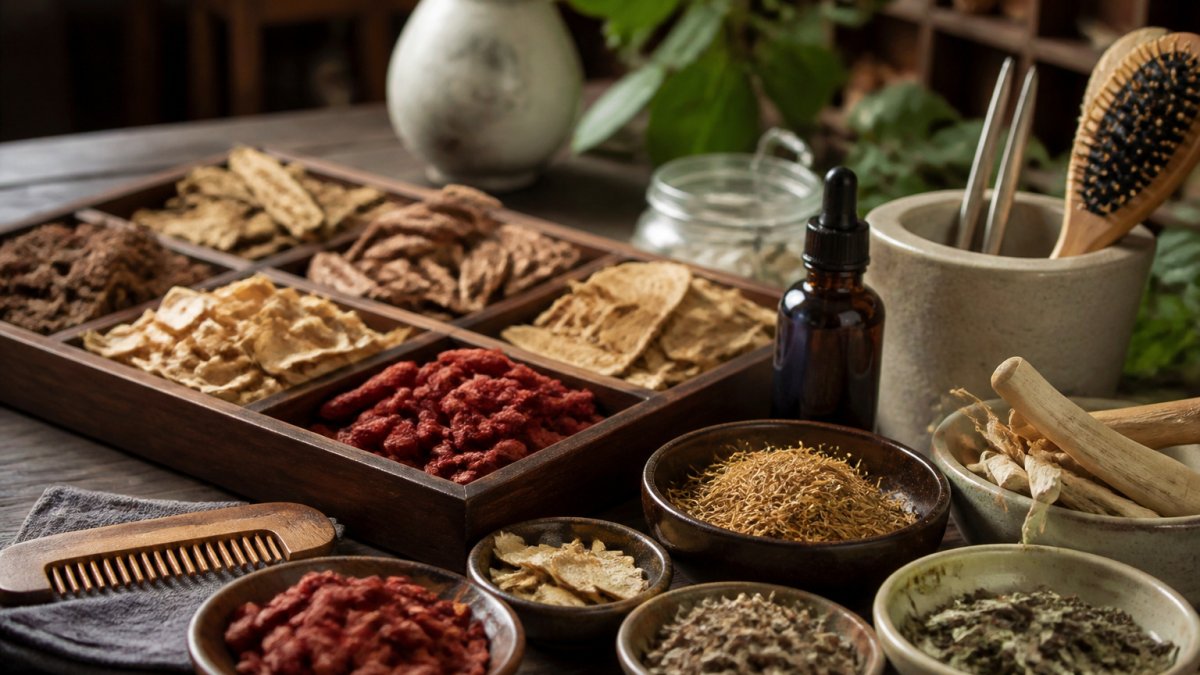
Several herbs appear repeatedly in TCM hair formulas. Their traditional roles are well documented, but the modern evidence behind them varies a great deal. The table below separates what tradition says from what research has actually shown, and it flags the cautions that matter most for scalp use. Read it as a map, not a prescription.
| Herb (pinyin / Latin) | Traditional role in TCM | What research suggests | Common preparations | Key cautions |
|---|---|---|---|---|
| He Shou Wu (Fo-Ti / Polygonum multiflorum) | Nourish blood and kidney essence; used traditionally for graying and thinning | Mostly laboratory and small human reports; no large controlled trials for scalp or hair outcomes | Decoction, capsules, topical tinctures | Liver injury reported with oral use; avoid with liver disease or heavy alcohol use; not for pregnancy or breastfeeding |
| Dong Quai (Dang Gui / Angelica sinensis) | Blood nourishment; often included in hair formulas | Limited human data; some laboratory work on circulation and inflammation | Decoction, capsules, combination formulas | May interact with blood thinners and hormone therapies; caution with heavy menstrual bleeding |
| Ginseng (Ren Shen / Panax ginseng) | Vitality and qi support | Small studies on general well-being; hair-specific evidence is thin | Capsules, teas, topical products | Can interact with diabetes medications and blood thinners; may affect blood pressure and sleep |
| Ligustrum (Nu Zhen Zi / Ligustrum lucidum) | Nourish liver and kidney yin; appears in hair formulas | Laboratory and traditional use; few human hair trials | Decoction, capsules, combination formulas | May interact with immune-modulating drugs; caution with hormone-sensitive conditions |
| Eclipta (Mo Han Lian / Eclipta prostrata) | Traditional hair and color support | Laboratory work on inflammation and pigmentation; limited human data | Decoction, topical oils, combination formulas | Generally well tolerated in traditional use; quality and contamination vary by source |
| Black sesame (Hei Zhi Ma / Sesamum indicum) | Food-based blood and kidney nourishment; hair color support | Nutrient content is well established; hair-color effects are not proven in controlled trials | Food, ground seed, oils, teas | Seed is a common allergen; high-calorie; quality varies |
He Shou Wu (Fo-Ti) and Ligustrum (Nu Zhen Zi)
He Shou Wu, also called Fo-Ti or Polygonum multiflorum, is one of the most widely cited hair herbs in TCM. It has a long traditional use for graying hair and thinning. Ligustrum, known as Nu Zhen Zi, is traditionally used to nourish the liver and kidneys in TCM terms, and it appears in many hair-focused formulas. Human studies on either herb for hair growth are limited, and He Shou Wu has been linked to liver injury in some reports, so it deserves careful review before use. If you are considering He Shou Wu, ask your clinician about baseline liver labs and avoid combining it with alcohol or other liver-stressing products.
Dong Quai, Ginseng, Eclipta, and Black Sesame
Dong Quai (Angelica sinensis, or Dang Gui) is traditionally used for blood nourishment and is often included in formulas for hair. Ginseng (Ren Shen) is valued for vitality and energy in TCM. Eclipta (Mo Han Lian) and black sesame (Hei Zhi Ma) are used for hair color and hair root support. Black sesame is also a food, so its contribution is easier to include in daily meals, though its effect on hair has not been clearly established in controlled trials.
Which Herbs Are Most Relevant to Scalp Comfort Specifically
Most of the famous hair herbs are framed around growth and color, not scalp skin. If your main concern is oiliness, itching, or flaking, the more relevant traditional categories are herbs used to clear heat, dry dampness, or cool the blood. A practitioner may suggest herbs such as Ku Shen (Sophora flavescens) or Bai Xian Pi (Dictamnus dasycarpus) in topical washes, though these are stronger and should be used under guidance rather than self-prescribed. The evidence for topical use is mostly traditional and laboratory-based, and patch-testing is wise before applying any herbal wash to an inflamed scalp.
How the Evidence Stacks Up
Sort the herbs into three rough tiers. Black sesame and ginseng have the most general research, but almost none of it is hair-specific. Dong Quai, Ligustrum, and Eclipta sit in a middle tier of laboratory and small human work. He Shou Wu has the longest traditional record but also the most serious safety signal. None of these herbs has the kind of large, randomized, controlled trial that would justify a strong regrowth claim, so treat any product marketing that implies otherwise with skepticism.
Start Your Hair & Scalp Healing Journey →
Chinese Herbal Remedies for Thinning Hair: Comparing Evidence by Goal
Keep expectations realistic. Most of the evidence for these herbs comes from traditional use, small studies, or laboratory work. A product that promises rapid regrowth is making a claim the evidence does not support. Ask any supplier for the specific study behind a claim, and note whether it involved humans.
Natural Scalp Care for Hair Growth: Practical Habits Alongside Herbs
Track changes over several months rather than weeks. Hair grows slowly, and shedding can increase for a period before improvement is visible. Keep notes with photos so you can judge progress honestly.
Safety, Interactions, and How to Choose a Quality Preparation
Herbal products are not automatically safe. Some herbs interact with blood thinners, diabetes medications, hormone treatments, and other drugs (Herb-Drug Interactions). Pregnancy, breastfeeding, liver disease, and kidney disease change what is appropriate. Tell any practitioner and your prescribing doctor about every supplement you take.
Herb-Specific Cautions Worth Knowing Before You Buy
- He Shou Wu (Fo-Ti): The most serious caution in this group. Oral use has been linked to liver injury, including cases serious enough to require medical care. Avoid it if you have liver disease, drink heavily, or take other liver-stressing medications. Stop and seek care if you notice jaundice, dark urine, fatigue, or upper-right abdominal pain.
- Dong Quai: May increase bleeding risk when combined with anticoagulants or antiplatelet drugs. Use caution with heavy menstrual bleeding and with hormone-sensitive conditions.
- Ginseng: Can lower blood sugar, so monitor if you take diabetes medications. May interact with blood thinners and some blood pressure drugs, and can cause insomnia or jitteriness in sensitive people.
- Ligustrum: May interact with immune-modulating drugs. Use caution with hormone-sensitive conditions.
- Topical herbal washes and oils: Patch-test on the inner forearm for 24 to 48 hours before applying to an inflamed scalp. Stop if burning, swelling, or spreading redness develops.
How to Judge a Preparation
When choosing a product, look for clear ingredient names including the Latin or pinyin name, the dosage per serving, a manufacturer address, and third-party testing for contaminants such as heavy metals, pesticides, and microbes. Be cautious of products that list only proprietary blends with no amounts. The U.S. Food and Drug Administration regulates dietary supplements after they reach the market, so quality checks fall largely on the buyer; see FDA guidance on dietary supplements.
A Practical Buying Checklist
If a product cannot clear these five checks, it is not a good candidate for a scalp or hair regimen, no matter how strong the marketing.
Booking a Scalp and Hair Consultation Before You Start Herbs
If your hair loss began suddenly, is patchy, or comes with pain, redness, or scarring, see a physician or dermatologist before starting any herbal program. Sudden or patterned loss can have medical causes that need diagnosis. The American Academy of Dermatology overview of hair loss describes common causes and when to seek evaluation.
Sophiatrichoholistic Hair Spa LLC integrates Traditional Chinese Medicine with clinical trichology and offers in-spa treatments and home hair growth solutions.
Frequently Asked Questions
Which are the best herbs for hair growth in Chinese medicine?
Herbs most often discussed in Traditional Chinese Medicine for hair include He Shou Wu, Dong Quai, ginseng, Ligustrum (Nu Zhen Zi), and black sesame. The research on them is limited, and most studies are small, laboratory-based, or not designed to test hair growth directly. Traditional use is not the same as proven effect. Results vary, and any herb should be discussed with a qualified clinician, especially if you take medication or have a diagnosed scalp condition.
Can Chinese herbs help with hair loss?
Some herbs used in Traditional Chinese Medicine are traditionally associated with reduced shedding, but clinical evidence for most of them is weak or inconclusive. Hair loss has many causes, including hormonal changes after pregnancy, thyroid problems, iron deficiency, medication effects, and autoimmune conditions such as alopecia areata. A medical evaluation helps identify the cause before you rely on any herbal approach.
Are Chinese herbs safe to use for hair and scalp concerns?
Herbs are not automatically safe because they are natural. Some interact with blood thinners, blood pressure medication, diabetes medication, hormone therapies, or other prescriptions. Preparations can also contain contaminants or undeclared ingredients when sourced from unregulated suppliers. Check with a licensed clinician or pharmacist before starting, particularly during pregnancy, breastfeeding, or while managing a chronic condition.
How can I promote scalp health naturally?
Daily habits matter as much as any herb. Gentle cleansing suited to your scalp type, avoiding harsh heat styling, managing stress, eating enough protein and iron, and not overwashing can all support scalp comfort. For persistent itching, flaking, redness, or scalp pain, see a dermatologist, because psoriasis and seborrheic dermatitis need medical treatment and do not resolve with diet or herbs alone.