 how-to
Holistic Scalp Health Treatment Plan: 7 Steps for 2026
Table of Contents
- Step 1: Assess Your Scalp and Identify Scalp Inflammation Causes
- Step 2: Build a Weekly Scalp Detox Routine
- Step 3: Eat for Follicle Health and Hormonal Balance
- Step 4: Manage Stress to Calm Scalp Inflammation
- Step 5: Find a Clinical Trichologist Near Me for Personalized Care
- Step 6: Adapt Your Plan for Specific Hair Textures
- Conclusion
- Frequently Asked Questions
Last Updated: September 28, 2026
Step 1: Assess Your Scalp and Identify Scalp Inflammation Causes
A holistic scalp health treatment plan starts with one honest question: what is your scalp actually doing? Most women treat symptoms they never diagnosed.
Scalp inflammation causes usually fall into a few groups. Product buildup, harsh sulfates, hormonal shifts, stress, and diet all play a role.
Common Triggers Behind Irritation and Flaking
- Product buildup that clogs follicles and traps oil
- Harsh surfactants that strip your scalp's natural barrier
- Hormonal shifts from pregnancy, menopause, or thyroid changes
- Chronic stress that raises cortisol and triggers flare-ups
- Food sensitivities that show up as itching and redness
Do a simple 10-minute check before you buy anything:
- Part your hair in four sections under bright light
- Look for redness, flaking, or oily patches
- Press gently. Does it hurt?
- Note how long your scalp stays oily after washing
- Write down what you ate and how you slept this week
That baseline tells you more than any product label.
Step 2: Build a Weekly Scalp Detox Routine
A scalp detox routine is a repeatable weekly practice that clears buildup, calms irritation, and restores your scalp microbiome. Skip it and everything else in your plan works harder for less.
Here's the part most articles leave out: your scalp is a barrier organ, and that barrier is under constant attack from things you never think to blame. Before you buy another scrub, audit your environment.
Environmental and Lifestyle Triggers Nobody Talks About
Water quality. Hard water carries dissolved calcium and magnesium. Those minerals bind to the surfactants in your shampoo, so you need more product to get a lather, and the residue left behind films the scalp and dulls the hair shaft. If your showerhead shows white scale, you have hard water. A chelating shampoo used once or twice a month, or a showerhead filter, removes that mineral film. This is one of the most common reasons a routine that worked in one home stops working in another.
Pillowcase material. Cotton pulls moisture from hair and creates friction along the hairline. Satin or silk reduces that friction and holds less product residue. If you wake up with an itchy hairline, the pillowcase is a variable worth changing before you change your shampoo.
Air pollution and smoke. Particulate matter settles on the scalp the same way it settles on skin. It oxidizes sebum, which is one route to irritation and that tight, coated feeling at the roots.
The Weekly Rhythm
- Once a week: gentle exfoliation with a soft silicone brush or a low-concentration salicylic acid scrub
- Twice a week: a scalp mask suited to your concern (hydrating for dryness, clay or charcoal for oiliness)
- Every wash day: two minutes of fingertip massage before rinsing to loosen buildup and support circulation
- Daily: keep heat tools and tight styles off your roots

Choosing Products That Respect Scalp pH Balance
Your scalp sits around pH 5.5. Anything far outside that range disrupts your barrier, and a disrupted barrier is an inflamed barrier.
Look for:
- Sulfate-free cleansers (sodium lauryl sulfate and sodium laureth sulfate are the usual culprits)
- Tea tree oil or apple cider vinegar in low concentrations
- Zinc pyrithione only if you have active dandruff
- Ketoconazole or selenium sulfide if flaking is persistent and greasy rather than dry
- Fragrance-free formulas if your scalp is sensitive
Step 3: Eat for Follicle Health and Hormonal Balance
Hair is one of the first things your body sacrifices when nutrients run low. Feed the follicle and the follicle feeds you back.
Start Your Hair & Scalp Healing Journey →
Focus on these:
- Protein at every meal for keratin building blocks
- Iron and B12 to support hair density
- Omega-3s to calm inflammation
- Zinc for sebum regulation and follicle health
- Vitamin D for hormonal balance
Step 4: Manage Stress to Calm Scalp Inflammation
Stress management is not soft advice. It is treatment. And the reason is measurable, not metaphorical.
The Biological Link Between Cortisol and Scalp Inflammation
When your body perceives a threat, the hypothalamic-pituitary-adrenal axis releases cortisol. Cortisol is not inherently bad. The problem is chronic elevation. Here is the chain that connects a stressful month to an inflamed scalp:
- Sustained cortisol shifts your immune response. It suppresses some immune activity while amplifying inflammatory signaling. The scalp, which has a dense network of blood vessels and hair follicles, is sensitive to that shift.
- Cortisol alters sebum production. Sebaceous glands respond to androgens and stress hormones. More sebum means more food for the Malassezia yeast that lives on everyone's scalp. When that yeast overgrows, you get the itching, flaking, and redness of seborrheic dermatitis.
- Stress impairs barrier repair. The stratum corneum, your scalp's outer barrier, repairs itself more slowly under chronic stress. A slower-repairing barrier loses moisture and lets irritants in.
- Stress disrupts the hair cycle. Cortisol pushes follicles into the resting phase prematurely. That is why a stressful event often shows up as shedding two to three months later, not the same week.
A Concrete Stress Protocol
Generic advice to 'relax' does nothing. These are specific, time-bound practices with a physiological rationale:
- Physiological sigh, 5 minutes daily. Two quick inhales through the nose, one long exhale through the mouth. This pattern offloads carbon dioxide and downshifts the sympathetic nervous system faster than slow breathing alone.
- Acupuncture or acupressure. Points along the scalp and neck are used in Traditional Chinese Medicine to reduce tension and support circulation.
- Consistent sleep and wake times. Cortisol follows a daily rhythm. Irregular sleep flattens that curve, which keeps stress hormones elevated into the evening.
- Movement you actually enjoy. Twenty to thirty minutes most days lowers circulating stress hormones. The type matters less than the consistency.
- Caffeine cutoff. Caffeine has a half-life of roughly five to six hours. An afternoon cup can still be active at bedtime, which fragments sleep and raises next-day cortisol.
Step 5: Find a Clinical Trichologist Near Me for Personalized Care
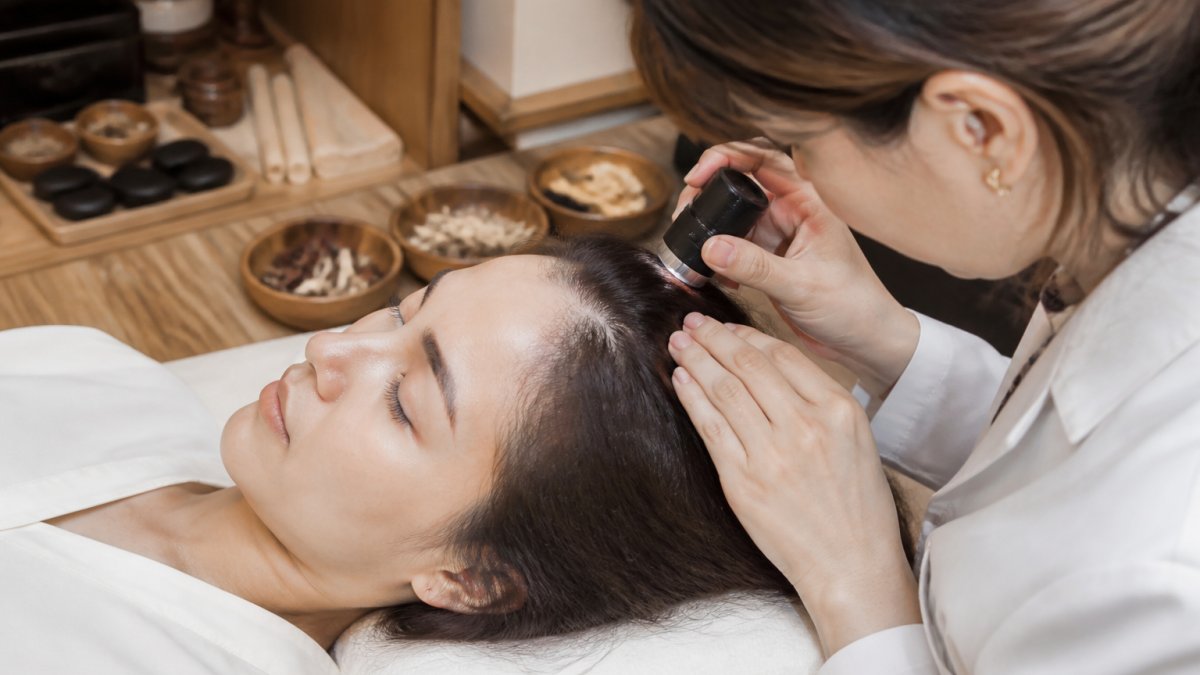
Searching for a clinical trichologist near me is where most DIY plans hit their ceiling. A trichologist looks at your scalp, hair density, and history together, then builds a plan around you.
What a Trichology Consultation Involves
- A full scalp and hair density assessment
- Review of your medical, hormonal, and lifestyle history
- A personalized treatment plan, not a template
- In-spa therapies plus home hair growth solutions
- Follow-up checkpoints to track real progress
Bring your questions. A good consultation should feel like a conversation, not a sales pitch.
Step 6: Adapt Your Plan for Specific Hair Textures
Texture changes everything. A plan built for fine, straight hair will fail on coily hair, and the reverse is just as true.
| Hair Texture | Wash Frequency | Key Focus | Watch Out For |
|---|---|---|---|
| Fine, straight | Every other day | Volume, gentle cleansing | Heavy oils that flatten roots |
| Wavy | 2-3 times weekly | Balance, light hydration | Buildup at the crown |
| Curly | Once weekly | Moisture, scalp hygiene | Dryness mistaken for dandruff |
| Coily | Every 7-10 days | Scalp circulation, protective styles | Tight braids and tension |
| Transitioning | Varies | Patience, gentle handling | Breakage at the line of demarcation |
Conclusion
Scalp health rarely fixes itself with one product. It takes a plan, patience, and a provider who looks at the whole picture.
Frequently Asked Questions
How can I improve my scalp health naturally?
A natural scalp health plan starts with a gentle weekly detox using diluted apple cider vinegar or a clay mask, daily massage to boost scalp circulation, and a diet rich in zinc, B vitamins, and omega-3s. Managing stress and getting enough sleep also support hormonal balance. If irritation, flaking, or shedding continues after four to six weeks of consistent care, see a clinical trichologist for a closer look at follicle health and barrier function.
What are the most common scalp inflammation causes?
Scalp inflammation causes include excess sebum production, product buildup, fungal overgrowth, and reactions to harsh sulfates or fragrances. Stress and hormonal shifts can amplify the response. In practice, many women find that switching to non-toxic, pH-balanced products and adding a weekly scalp detox routine reduces redness and itching within a few weeks. Persistent inflammation deserves a professional evaluation, since it can affect hair density over time.
How often should I do a scalp detox routine?
For most people, a gentle scalp detox once a week works well. If you use heavy styling products or have an oily scalp, you can do it twice weekly. Alternate between exfoliating with a scalp mask and massaging with natural oils. Over-cleansing can strip natural oils and disrupt the scalp microbiome, so pay attention to how your scalp feels and adjust. Those with sensitive or inflamed scalps should start with every other week.
What should I expect during a clinical trichology consultation?
A clinical trichology consultation typically includes a detailed history, a scalp examination using magnification, and a review of your hair care routine, diet, and stress levels. The trichologist may assess follicle health, sebum production, and signs of conditions like seborrheic dermatitis or psoriasis. You will leave with a personalized scalp health treatment plan that may combine in-spa therapies and home care. Expect the first visit to last 45 to 60 minutes.