 comparison
TCM vs Dermatology for Scalp Health: Which Works?
Table of Contents
- How a Dermatologist Diagnoses and Treats Scalp Conditions
- What Traditional Chinese Medicine Looks For: The Internal Imbalance
- Clinical Trichology vs Dermatology: Where the Two Overlap
- Can Acupuncture Stop Hair Thinning? What the Evidence Shows
- TCM Herbal Remedies for Scalp Inflammation and Seborrhoeic Dermatitis
- Comparing Safety, Diagnosis, and Cost: A Side-by-Side Look
- When to Combine Both Approaches for Chronic Scalp Issues
- Frequently Asked Questions
Last Updated: September 6, 2026
When chronic scalp conditions like seborrhoeic dermatitis or psoriasis persist despite months of prescribed topicals, many women ask whether the problem is being treated at the wrong level. Dermatology excels at suppressing visible inflammation, while Traditional Chinese Medicine asks why the scalp became inflamed in the first place. This guide from Sophiatrichoholistic Hair Spa LLC breaks down how each system diagnoses, treats, and prevents scalp issues.
The two approaches are not enemies, but they operate on different assumptions. Dermatology treats the scalp as a biological organ with measurable markers like sebum production and fungal overgrowth. TCM views the scalp as a reflection of internal balance, where blood deficiency, kidney essence, and qi circulation determine whether hair follicles thrive or fail.
:::verdict Winner: It depends on your goal. Choose dermatology for acute flare-ups, diagnostic testing, and FDA-approved medical interventions. Choose TCM for chronic, recurring conditions where you want to address the internal imbalance driving the symptoms. Many women with long-term scalp issues ultimately benefit from both. :::
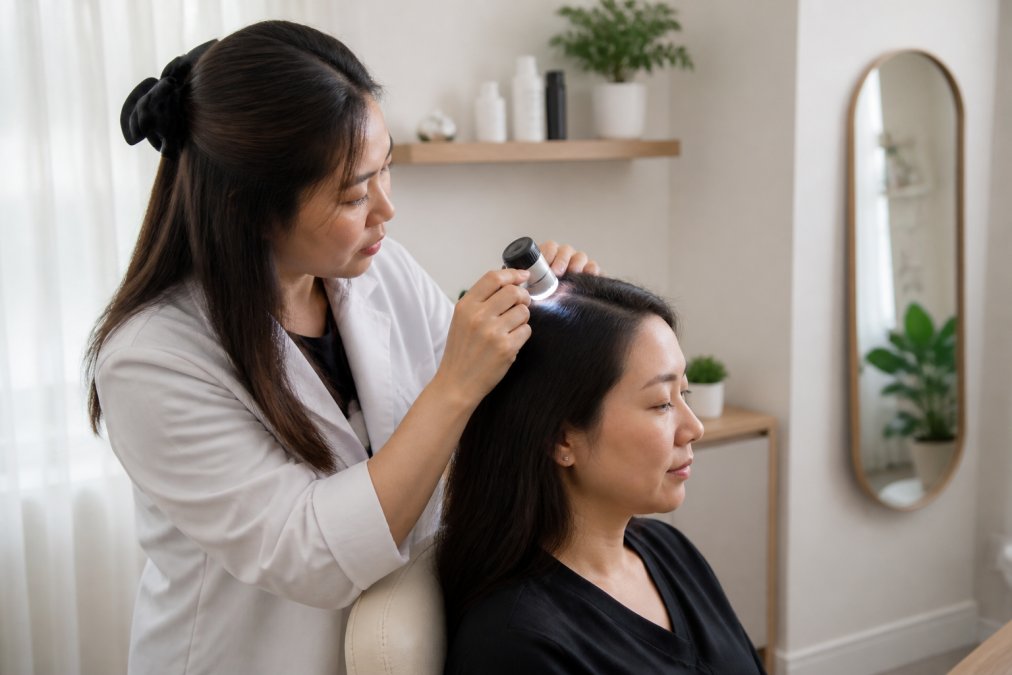
How a Dermatologist Diagnoses and Treats Scalp Conditions
A dermatologist starts with a visual and dermatoscopic examination, often followed by a scalp biopsy or fungal culture when the diagnosis is unclear. Conditions like psoriasis, seborrhoeic dermatitis, and androgenetic alopecia have distinct presentations, and a dermatological assessment can usually identify them with high confidence.
Treatment follows a stepped protocol: medicated shampoos with ketoconazole or salicylic acid, topical corticosteroids, and for androgenetic alopecia, minoxidil or finasteride. These are backed by FDA approval, but they manage symptoms rather than resolve the underlying tendency toward chronic inflammation. Many women improve while using medication but revert once they stop.
What Traditional Chinese Medicine Looks For: The Internal Imbalance
TCM asks why the scalp keeps producing excess heat or damp-heat. Instead of isolating the scalp, a practitioner evaluates the whole person through pulse and tongue diagnosis and a detailed history of digestion, sleep, stress, and menstrual patterns.
The TCM framework connects scalp health to two core resources: Blood and Kidney essence. Blood deficiency can leave the scalp undernourished, producing dry, thinning hair and a pale scalp. Kidney essence, which declines naturally with age and stress, governs the hair growth cycle at its deepest level. When qi circulation stagnates or excess heat rises to the head, the result can be an itchy, inflamed scalp that resists topical treatment.
Dermatology sees sebum and inflammation as problems to suppress. TCM sees them as signals of an internal imbalance needing correction. This systemic perspective often explains why seborrhoeic dermatitis keeps returning despite every medicated shampoo.
Clinical Trichology vs Dermatology: Where the Two Overlap
Trichology is a paramedical discipline focused on hair and scalp conditions, bridging cosmetic care and medical treatment. A clinical trichologist uses digital microscopy to assess follicular health, scalp barrier function, and the ratio of terminal to vellus hair.
Dermatology remains the only route to prescriptions and surgery, but trichology offers time, continuity, and a holistic approach. Where a dermatologist may spend ten minutes confirming a diagnosis, a trichologist conducts a longer assessment covering lifestyle, nutrition, and hair care.
This overlap matters because seborrhoeic dermatitis and psoriasis require ongoing management. Combining dermatological diagnosis with trichological monitoring and TCM support can address both the acute flare and the recurring pattern.
Can Acupuncture Stop Hair Thinning? What the Evidence Shows
Can acupuncture stop hair thinning? Evidence is emerging but not conclusive. Acupuncture is believed to improve scalp microcirculation, reduce inflammation, and address stress, a known contributor to telogen effluvium.
From a TCM perspective, acupuncture points on the scalp, liver, and kidney meridians are selected to nourish blood, move qi, and calm the nervous system. Clinical experience suggests that women with stress-related shedding or postpartum hair loss often respond well, particularly when acupuncture is combined with herbal medicine and dietary guidance.
Acupuncture supports the conditions for hair growth rather than directly forcing it. Visible improvements require consistent treatment over several months. For androgenetic alopecia, acupuncture alone is unlikely to reverse the process, though it may complement other treatments.
TCM Herbal Remedies for Scalp Inflammation and Seborrhoeic Dermatitis
TCM herbal remedies for scalp inflammation are among the most practical applications of this medicine. Decoctions and topical rinses clear excess heat, resolve dampness, and cool the blood, addressing the patterns that drive seborrhoeic dermatitis and scalp psoriasis.
Commonly used herbs include Rehmannia to nourish blood and cool heat, Paeonia to soothe the liver and reduce inflammation, and various cooling, dampness-resolving herbs selected by the practitioner. These are prescribed as personalized formulas, not over-the-counter products, because the correct formula depends on your specific pattern of imbalance. What works for a woman with damp-heat and oily scaling differs from what suits someone with blood deficiency and dry flaking.
Herbal treatment targets the internal imbalance rather than just the scalp surface. The trade-off is that decoctions require consistency and patience, often taking months to shift a chronic pattern. A practitioner reassesses the formula at each visit based on tongue and pulse changes.
Comparing Safety, Diagnosis, and Cost: A Side-by-Side Look
The tcm vs dermatology decision often comes down to safety profiles, diagnostic methods, and long-term cost. Here is the breakdown that most articles miss.
Diagnostic Process: What Actually Happens in the Room
A dermatologist's diagnosis is rooted in visual and laboratory evidence. A dermatoscopic exam magnifies the scalp to reveal scaling, erythema, and follicular dropout. If unclear, a 4-mm punch biopsy can definitively differentiate psoriasis from seborrhoeic dermatitis or diagnose scarring alopecia. Fungal cultures and blood tests for thyroid, ferritin, or vitamin D are common add-ons.
A TCM practitioner uses a different toolkit. Pulse diagnosis palpates the radial artery at three depths, while tongue diagnosis examines color, coating, and shape to identify patterns like Blood deficiency or Damp-Heat. The intake covers sleep, digestion, stress, menstrual regularity, and emotional tendencies. The goal is a pattern of imbalance, not a disease label.
Dermatology offers high diagnostic specificity but a narrow view of the patient. TCM offers a broad systemic view but no objective biomarker. For seborrhoeic dermatitis, a dermatologist tells you what it is; a TCM practitioner tells you why your body keeps producing the environment for it.
Safety Profiles and the Missing Conversation: Drug-Herb Interactions
Dermatology is FDA-regulated with known side-effect profiles. Topical corticosteroids are effective for short-term flares, but chronic use risks skin atrophy, telangiectasia, and rebound flares. Oral finasteride carries systemic risks, including sexual dysfunction and mood changes, and is not approved for premenopausal women (the FDA).
Start Your Hair & Scalp Healing Journey →
TCM herbs are generally low-risk when prescribed by a licensed practitioner, but they are not inert. Danshen (Salvia miltiorrhiza) and Dong Quai (Angelica sinensis) have blood-thinning properties and can potentiate anticoagulants like warfarin (nccih.nih.gov). Immune-modulating herbs could theoretically interfere with immunosuppressants like methotrexate. Ensure both your dermatologist and TCM practitioner know your full medication list. Herbal quality varies by supplier, so source from practitioners who use third-party tested products.
Cost-Benefit Analysis: What You Will Actually Pay Over a Year
Cost is where the two systems diverge most sharply. Here is a realistic comparison based on typical out-of-pocket and insurance-covered scenarios.
Dermatology Route: A standard visit with a dermatologist is typically covered by insurance after a copay, often $30 to $60 per visit. A scalp biopsy may add a few hundred dollars, but usually is covered if medically indicated. Prescription topicals like ketoconazole shampoo or clobetasol solution are typically $30 to $80 per fill with insurance. If you require a biologic like dupilumab for severe atopic dermatitis, costs can run into the thousands per dose, though patient assistance programs often mitigate this. The annual out-of-pocket cost for a well-managed case is often under $500, assuming insurance coverage.
TCM Route: TCM is almost always out-of-pocket. An initial consultation with a licensed acupuncturist or TCM practitioner typically ranges from $100 to $200, with follow-up sessions at $75 to $150. A course of treatment for a chronic scalp condition usually involves weekly sessions for 8 to 12 weeks, which translates to $600 to $1,800 for the acupuncture component alone. Herbal formulas, whether as raw decoctions or granules, add another $50 to $150 per month. A realistic annual budget for consistent TCM care is $2,000 to $4,000.
TCM is not cheaper; it may reduce the cycle of recurring flares that leads to repeated dermatology visits. The most cost-effective strategy is to use dermatology for diagnosis and acute flares, then transition to TCM and trichology for maintenance. This avoids indefinite TCM-only costs while reducing long-term corticosteroid dependence.
When to Combine Both Approaches for Chronic Scalp Issues
For chronic scalp conditions, the most effective path is often integrative. A dermatologist confirms the diagnosis and rules out conditions requiring medical intervention, while a TCM practitioner addresses the internal imbalance that keeps it returning. The challenge is sequencing and coordination.
The Standard Integrative Protocol: A Step-by-Step Sequence
Most practitioners recommend a structured approach rather than a random mix of appointments.
Step 1: Establish a definitive dermatological diagnosis. If you have not had a scalp biopsy or a dermatoscopic exam, start there. This is non-negotiable. Conditions like scalp psoriasis, seborrhoeic dermatitis, and lichen planopilaris require different management strategies, and a TCM pattern diagnosis alone cannot distinguish between them. A dermatologist can also rule out less common but serious conditions like cutaneous T-cell lymphoma, which can masquerade as chronic dermatitis.
Step 2: Identify the TCM pattern with a licensed practitioner. Once you have a Western diagnosis, a TCM practitioner can assess your specific pattern. For seborrhoeic dermatitis, the most common patterns are Damp-Heat in the Liver and Gallbladder or Blood-Heat with Wind. For androgenetic alopecia, the pattern is often Kidney essence deficiency with Blood stasis. The TCM diagnosis determines the herbal formula and acupuncture point selection.
Step 3: Use Western topicals for acute flares, TCM for the underlying pattern. During an active flare, a short course of a mid-potency topical corticosteroid or an antifungal shampoo is appropriate to bring the inflammation under control quickly. Concurrently, TCM herbs and acupuncture work to shift the internal environment so that the flare does not recur when the topical is stopped. This is the key difference from a purely dermatological approach: the goal is not just to suppress the flare but to change the terrain that allowed it to develop.
Step 4: Coordinate care and monitor for interactions. Your dermatologist and TCM practitioner should both be aware of your full treatment plan. If you are prescribed an oral medication like spironolactone for hormonal acne or hair thinning, your TCM practitioner needs to know, as some herbs can affect electrolyte balance or blood pressure. Similarly, if you are taking a TCM formula that includes blood-moving herbs, your dermatologist should be informed before any surgical procedure.
What the Evidence Says About Combination Therapy
Clinical research on combining TCM and Western dermatology is limited but growing. A 2021 systematic review in the Journal of Alternative and Complementary Medicine found that combining TCM herbal medicine with conventional topical therapy improved psoriasis outcomes with no significant increase in adverse events (PubMed). For androgenetic alopecia, acupuncture combined with minoxidil has shown modest improvements in hair density, though the evidence base is small.
Topical corticosteroids and antifungals are highly effective for acute control, but relapse is well-documented. Adding a TCM formula that clears Damp-Heat and a dietary protocol that reduces inflammatory triggers often extends the remission period significantly.
Red Flags: When Not to Combine
Combination therapy is not for everyone. If you have an autoimmune condition like pemphigus or lupus, or are pregnant or nursing, do not start herbal formulas without approval from both your obstetrician and dermatologist. If you are on immunosuppressive therapy, a dermatology-only approach is safer.
The Role of the Integrative Practitioner
This combined approach aligns with the philosophy of Sophiatrichoholistic Hair Spa LLC. By integrating Traditional Chinese Medicine with advanced clinical trichology, the team addresses root causes such as alopecia, thinning, and scalp inflammation. Every client receives personalized care designed to restore internal balance, improve scalp health, and support sustainable hair regeneration, with both in-spa treatments and home care protocols.
Start with a dermatological assessment to establish your diagnosis. If a confirmed condition like seborrhoeic dermatitis or psoriasis keeps recurring, that is the signal to explore whether an internal imbalance is driving the pattern. A practitioner who understands both TCM and trichology can coordinate your care and help you taper conventional treatments under medical supervision.
Frequently Asked Questions
What does Chinese medicine say about seborrheic dermatitis?
TCM views seborrhoeic dermatitis as a sign of internal imbalance, often linked to damp-heat in the body. Instead of treating only the visible flakes and oiliness, a practitioner looks for patterns like excess heat or blood deficiency through pulse and tongue diagnosis. Herbal decoctions and acupuncture aim to clear that internal heat and regulate scalp sebum from within, which is why the approach differs from topical dermatology protocols.
Can acupuncture stop hair thinning, and how long does it take?
Acupuncture may help stop hair thinning by improving qi circulation and blood flow to the scalp, which supports follicular health. Results depend on the root cause, such as postpartum shedding or androgenetic alopecia. Most TCM practitioners recommend consistent weekly sessions for several months, since hair growth cycles are slow. A realistic timeline is 3 to 6 months before you notice reduced shedding and new terminal hair.
What is the difference between clinical trichology and dermatology?
Dermatology is a medical specialty focused on diagnosing and treating skin, hair, and nail diseases, often with prescription treatments. Clinical trichology is a specialized field dedicated specifically to hair and scalp health, combining diagnostic techniques with holistic and nutritional approaches. A trichologist may use scalp analysis and microscopy, while a dermatologist can order blood tests and prescribe medications. For chronic conditions, the two approaches complement each other well.
Can TCM and dermatology treatments be used at the same time?
Yes, many people use both approaches together, and integrative medicine is growing in popularity. For example, a dermatologist might prescribe a topical treatment for seborrhoeic dermatitis while a TCM practitioner addresses the internal imbalance with herbs and acupuncture. Clear communication between your providers is essential to avoid interactions. Always tell both practitioners about every treatment you are using before combining them.
Are TCM herbal remedies for scalp inflammation safe?
TCM herbal remedies can be safe when prescribed by a qualified practitioner who has assessed your individual constitution. However, herbs are not regulated like prescription drugs, so quality and potency vary. A licensed acupuncturist or herbalist will tailor a formula to your specific pattern and monitor for side effects. Never self-prescribe herbal decoctions for scalp inflammation without professional guidance, especially if you are pregnant or taking other medications.