 How-to
TCM Approach to Hair Growth: A Practical Guide
Table of Contents
- Understanding Hair Loss Through a TCM Lens
- Acupuncture for Hair Loss: How It Works
- Chinese Herbs for Hair Growth: Selection and Safety
- Qi and Blood Circulation: The Foundation of Hair Health
- Scalp Massage, Acupressure, and Gua Sha for Hair Regeneration
- Building Your TCM Hair Growth Plan: Realistic Timelines and Red Flags
- Frequently Asked Questions
Last Updated: October 7, 2026
Understanding Hair Loss Through a TCM Lens
Hair loss affects millions of women, yet conventional dermatology often treats it as a isolated scalp problem. Traditional Chinese Medicine takes a different view. It sees hair as a window into your internal health. At Sophiatrichoholistic Hair Spa LLC, we combine TCM principles with modern clinical trichology to address what's actually driving your hair thinning or shedding.
How TCM Explains Hair Loss and Hair Growth
In TCM, hair loss isn't just about follicles. It reflects imbalances deeper in your body. Your hair depends on the health of your blood, your Qi (vital energy), and your kidney essence. When any of these systems weaken, your hair shows it first.
TCM identifies several patterns behind hair loss:
- Blood deficiency, Your scalp doesn't receive enough nourishment
- Kidney essence decline, Your body's foundational energy weakens with age or stress
- Qi and blood stagnation, Poor circulation prevents nutrients from reaching hair follicles
- Heat in the blood, Inflammation damages hair roots
- Spleen weakness, Poor digestion means nutrients never get absorbed
Each pattern requires a different treatment approach. That's why a one-size-fits-all shampoo rarely works.
Kidney Essence and Hair Vitality
Your kidney essence, or Jing, is foundational to hair health in TCM. Think of it as your body's reserve battery. Jing governs growth, reproduction, and aging.
Jing depletes naturally over time, but stress, poor sleep, overwork, and hormonal shifts accelerate the process. Postpartum hair loss, for example, occurs because pregnancy drains kidney essence. Rebuilding it takes time and the right support.
What weakens kidney essence:
- Chronic stress and mental strain
- Insufficient sleep or poor sleep quality
- Excessive sexual activity or reproductive demands
- Overwork without adequate rest
- Poor nutrition and digestive weakness
Strengthening kidney essence requires consistent effort. Herbal support, acupuncture, and lifestyle changes work together to restore this vital reserve.
Blood Deficiency and Scalp Nourishment
Blood deficiency is one of the most common TCM patterns in hair loss.
When blood is deficient, your scalp doesn't receive adequate nourishment. Hair becomes thin, dry, and prone to shedding.
Blood deficiency develops from poor digestion, inadequate nutrition, heavy menstrual bleeding, or chronic stress. Women are particularly vulnerable because menstruation depletes blood monthly.
Signs of blood deficiency affecting hair:
- Thin, brittle, or dull hair
- Slow hair growth or no growth
- Dry scalp despite oiliness elsewhere
- Pale complexion and fatigue
- Irregular or heavy menstrual periods
Building blood takes time. It requires nourishing foods, digestive support, and sometimes herbal tonics. Acupuncture can also stimulate your body's natural blood-building capacity.
Acupuncture for Hair Loss: How It Works
Acupuncture activates your body's own healing response. Needles placed at specific points trigger blood flow, reduce inflammation, and rebalance your energy systems. For hair loss, acupuncture works on multiple levels: it strengthens kidney essence, improves scalp circulation, and addresses the root imbalance driving your shedding.
Acupuncture works best as part of a comprehensive approach that includes herbal support, scalp care, and addressing lifestyle factors. It's not a quick fix. Most people see gradual improvement over three to six months of consistent treatment.
Acupuncture Points for Hair Growth and Scalp Health
Certain acupuncture points are particularly effective for hair regeneration. Your practitioner selects points based on your specific TCM pattern.
Common points for hair health:
- GV20 (Baihui), Located at the crown; strengthens Qi and kidney essence
- GV24 (Shenting), On the forehead; calms the mind and supports hair growth
- UB23 (Shenshu), On the lower back; directly tonifies kidney essence
- ST36 (Zusanli), On the leg; strengthens digestion and overall vitality
- LI4 (Hegu), On the hand; regulates Qi and blood circulation
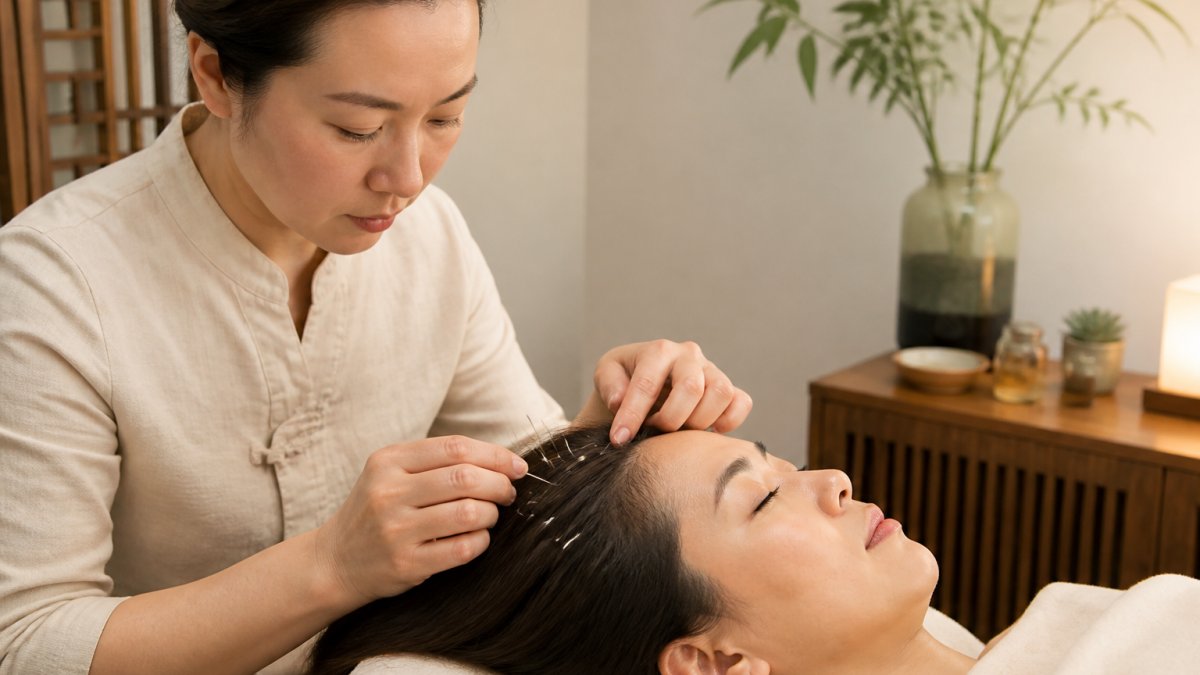
Scalp acupuncture is also gaining recognition. Needles placed directly on the scalp stimulate local blood flow and may trigger dormant hair follicles.
What to Expect from Treatment
Your first acupuncture session includes a thorough intake. Your practitioner asks about your menstrual cycle, digestion, sleep, stress, and family history.
During treatment, you lie comfortably while needles are inserted. Most people feel a slight sensation when the needle enters, then relaxation.
Frequency matters. Most practitioners recommend weekly or twice-weekly sessions for the first 8 to 12 weeks. As you improve, frequency decreases.
Chinese Herbs for Hair Growth: Selection and Safety
Chinese herbal medicine offers powerful tools for hair regeneration. Herbs work by tonifying blood, strengthening kidney essence, improving circulation, and reducing inflammation. They work synergistically, a formula is stronger than any single herb.
Common herbs for hair health include ginseng (boosts Qi), rehmannia (nourishes blood), and dang gui (improves circulation). Your practitioner combines these into a personalized formula based on your pattern.
Common Herbs and Their Roles
Tonifying kidney essence:
- Ginseng (ren shen), Strengthens overall vitality and Qi
- He shou wu (polygonum), Directly supports hair growth and darkening
- Goji berry (gou qi zi), Nourishes kidney and liver blood
Nourishing blood:
- Dang gui (Chinese angelica), Moves blood and improves circulation
- Rehmannia (shu di huang), Deeply nourishes blood and yin
- Shou wu (polygonum), Supports hair growth and pigmentation
Improving circulation:
- Salvia (dan shen), Moves blood stagnation
- Peony (bai shao), Nourishes blood and calms the nervous system
- Ligusticum (chuan xiong), Invigorates blood flow
Reducing inflammation:
- Scutellaria (huang qin), Clears heat and inflammation
- Lonicera (jin yin hua), Anti-inflammatory and antimicrobial
Herbal formulas are typically taken as teas, powders, or capsules. Dosing and duration depend on your condition and response. Many people take herbs for three to six months before noticing significant hair regrowth, but individual results may vary.
Quality, Interactions, and When to Consult a Professional
Herb quality varies dramatically. Poor-quality herbs contain fillers, pesticides, or incorrect plant species. Always source herbs from a licensed acupuncturist or reputable supplier who tests for purity and potency.
Start Your Hair & Scalp Healing Journey →
Some herbs interact with medications. If you take blood thinners, hormone medications, or other prescriptions, inform your practitioner before starting herbal support.
Red flags, consult a doctor before starting herbs:
- You take prescription medications
- You're pregnant or breastfeeding
- You have liver or kidney disease
- You have a bleeding disorder
- You've had allergic reactions to herbs before
A qualified practitioner evaluates your full health picture before recommending herbs. This is not something to self-treat with over-the-counter supplements.
Qi and Blood Circulation: The Foundation of Hair Health
Hair health depends on strong Qi and blood circulation. Qi is the force that moves blood through your vessels and delivers nutrients to every cell.
Poor circulation is why stress, sedentary work, and inadequate sleep trigger hair loss. These factors slow Qi flow and allow blood to stagnate. Over time, your hair follicles weaken.
Improving circulation requires multiple approaches:
- Acupuncture, Directly stimulates Qi movement
- Herbal tonics, Support blood production and circulation
- Movement, Walking, yoga, or tai chi activate Qi flow
- Scalp stimulation, Massage and acupressure wake up local circulation
- Stress management, Chronic tension blocks Qi; meditation and breathing help release it
Think of your circulation as a river. When the river flows freely, nutrients reach every bank. When it stagnates, some areas dry out.
Scalp Massage, Acupressure, and Gua Sha for Hair Regeneration
You don't need acupuncture needles to stimulate your scalp. Massage, acupressure, and gua sha activate blood flow and trigger hair regeneration.
Scalp massage involves gentle, firm pressure applied with your fingertips. Work in circular motions across your entire scalp for 5 to 10 minutes daily.
Acupressure targets specific points on the scalp and body. Press these points with your thumb or finger for 30 to 60 seconds:
- GV20 (crown), Strengthens Qi and kidney essence
- GV24 (forehead center), Calms the mind and supports hair growth
- GB20 (base of skull), Relieves tension and improves circulation
Gua sha uses a smooth tool to scrape the scalp gently. This mobilizes stagnant blood and Qi.
These techniques work best when done consistently.
Building Your TCM Hair Growth Plan: Realistic Timelines and Red Flags
A real TCM approach to hair growth takes time. Hair grows slowly, about half an inch per month. Regrowing lost hair or thickening thinning hair typically requires three to six months of consistent treatment.
This timeline frustrates people accustomed to quick fixes. But it's realistic. Your body needs time to rebuild blood, strengthen kidney essence, and activate dormant follicles. Rushing the process with excessive treatment often backfires.
Creating a Personalized Self-Care Routine
Your TCM plan should include four pillars:
- Professional treatment, Weekly or twice-weekly acupuncture for 8 to 12 weeks, then maintenance
- Herbal support, A personalized formula taken daily for three to six months
- Daily self-care, Scalp massage, acupressure, and stress management
- Lifestyle adjustments, Better sleep, less stress, nourishing diet, regular movement
Start with a consultation to identify your TCM pattern. Your practitioner designs a plan specific to your imbalance. Generic treatment doesn't work because your hair loss has a specific cause.
A realistic three-month plan looks like:
- Weeks 1-4: Acupuncture twice weekly, herbal formula, daily scalp massage
- Weeks 5-8: Acupuncture once weekly, continued herbs, scalp massage
- Weeks 9-12: Acupuncture once weekly or every other week, continued herbs, scalp massage
- Month 4 onward: Maintenance acupuncture monthly, herbs as needed, daily self-care
You'll likely notice small changes first: better sleep, less scalp inflammation, improved energy. Hair regrowth follows as your internal balance improves.
When to Seek Medical Evaluation
Not all hair loss responds to TCM alone. Some conditions require conventional medical diagnosis first.
See a dermatologist if:
- Hair loss is sudden or severe
- You have scalp pain, bleeding, or oozing
- You have bald patches (alopecia areata)
- You recently started a new medication
- You have signs of thyroid disease (fatigue, weight changes, temperature sensitivity)
- Your hair loss follows a specific pattern (receding hairline, crown thinning)
TCM works best when you understand what you're treating. A dermatologist can rule out infections, autoimmune conditions, or medication side effects.
Postpartum hair loss, for example, is usually hormonal and self-limiting. But TCM speeds recovery by rebuilding blood and kidney essence depleted by pregnancy.
Chronic scalp conditions like seborrheic dermatitis or psoriasis respond well to TCM because they reflect internal heat and dampness.
Hair loss doesn't have to be permanent.
Frequently Asked Questions
How does Traditional Chinese Medicine explain hair loss?
TCM views hair loss as a sign of internal imbalance, typically involving deficiency in kidney essence (Jing), blood nourishment, or disrupted Qi and blood circulation. Hair health reflects the state of the kidneys and liver in TCM theory. Rather than treating only the scalp, TCM addresses the root cause by restoring internal balance through acupuncture, herbs, and lifestyle adjustments. The approach recognizes that different people may have different underlying patterns, some experience hair loss due to blood deficiency, others due to Qi stagnation or kidney weakness.
Can acupuncture for hair loss actually work, or is it just placebo?
Acupuncture is believed to stimulate blood circulation to the scalp and restore Qi flow, which TCM practitioners say supports hair follicle health. Some individuals may experience improvement in hair density and shedding with consistent treatment. However, evidence quality varies, and results are not guaranteed. Acupuncture works best as part of a comprehensive approach that includes herbal support, scalp care, and addressing lifestyle factors. Individual outcomes depend on the underlying cause of hair loss, treatment consistency, and how your body responds. A qualified practitioner can assess whether acupuncture is appropriate for your specific pattern.
How long does it take to see results from a TCM approach to hair growth?
Hair growth cycles are slow by nature, it typically takes 3 to 6 months to notice visible changes in hair density or reduction in shedding, even with consistent treatment. Some people report initial improvements in scalp health or reduced inflammation within 4 to 8 weeks. The timeline depends on the severity of hair loss, the root cause, treatment frequency, and your body's response. Sustainable hair regeneration is a gradual process. Expecting dramatic results in 2 to 3 months sets unrealistic expectations. Commitment to a personalized plan over several months gives TCM methods the best chance to work.
What should I ask a practitioner before starting Chinese herbs for hair loss?
Ask about the quality and sourcing of herbs, whether they are tested for contaminants, and if they are appropriate for your specific hair loss pattern. Inquire about potential interactions with any medications or supplements you take, and how long you should expect to take the herbs. Ask the practitioner how they diagnosed your pattern (blood deficiency, kidney essence weakness, Qi stagnation, etc.) and why those specific herbs address it. Request clarity on realistic timelines, how they will monitor progress, and what adjustments they might make if you do not see improvement. A trustworthy practitioner will welcome these questions and provide clear, honest answers.