 ultimate-guide
TCM Approach for Female Alopecia: A 2026 Guide
Table of Contents
- Understanding Female Alopecia and Its Root Causes
- Can Acupuncture Stop Hair Thinning?
- TCM Herbs for Hair Growth: What the Research Shows
- Holistic Treatment for Female Pattern Baldness
- TCM Syndrome Differentiation: Matching Treatment to Your Pattern
- Integrating TCM With Western Medicine and Trichology
- Safety, Contraindications, and What to Expect
- Frequently Asked Questions
Last Updated: September 26, 2026
Understanding Female Alopecia and Its Root Causes
Female alopecia is progressive hair thinning driven by genetics, hormonal shifts, inflammation, or stress. At Sophiatrichoholistic Hair Spa LLC, we specialize in women experiencing postpartum hair loss or thinning, women diagnosed with various forms of alopecia, and women struggling with scalp inflammation and oiliness who have not found success with conventional dermatological treatments.
The most common forms include:
- Androgenic alopecia: genetic, pattern-based thinning along the part and crown
- Telogen effluvium: diffuse shedding triggered by stress, illness, or childbirth
- Alopecia areata: autoimmune patches that can appear suddenly
- Scarring alopecias: inflammatory conditions that damage follicles permanently if untreated
How TCM Views Hair Loss Differently
Traditional Chinese Medicine treats hair as a marker of internal balance, not an isolated scalp problem. Hair health depends on kidney essence, blood quality, and the free movement of qi; when blood is deficient or qi stagnant, follicles lose nourishment and shedding follows.
Can Acupuncture Stop Hair Thinning?
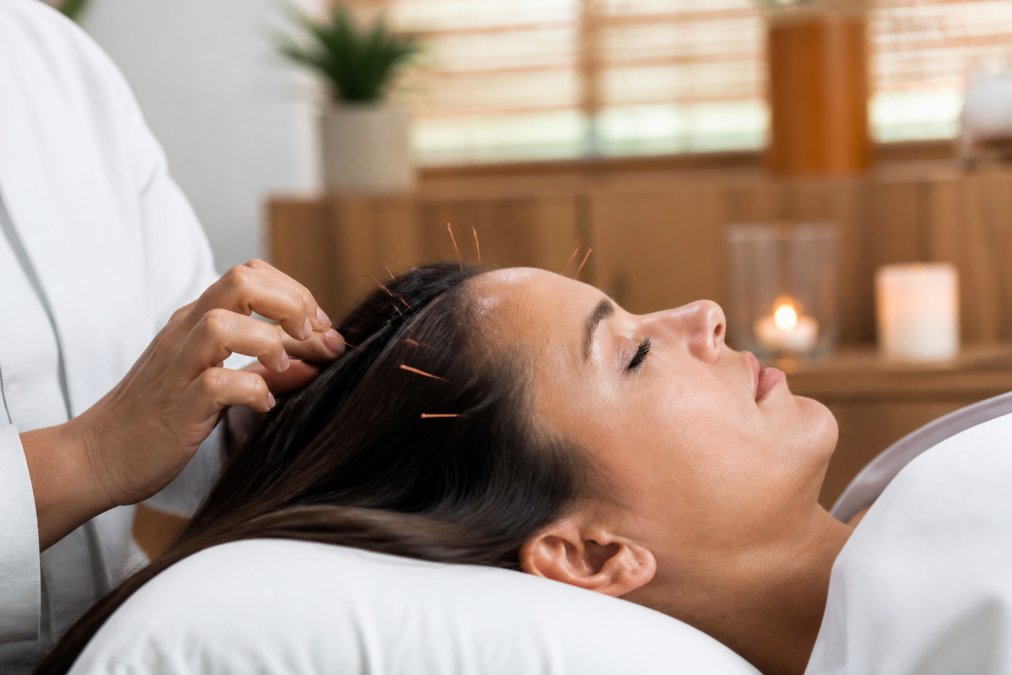
Acupuncture can help slow hair thinning in many women, but works best within a broader plan. Fine needles along the scalp and body stimulate blood flow to the follicle, calm the nervous system, and support hormonal regulation.
Key Acupuncture Points and Scalp Microcirculation
Points for hair loss serve three goals: moving blood to the scalp, calming stress, and supporting kidney and liver function. Common selections include scalp points along the governing vessel and gallbladder meridian, plus body points on the leg and forearm.
TCM Herbs for Hair Growth: What the Research Shows
TCM herbs for hair growth are prescribed as formulas matched to your pattern, not your diagnosis. The goal is internal nutritional support: nourishing blood, toning kidney essence, and clearing the inflammation that keeps follicles resting.
Commonly used herbs in clinical practice include:
- He Shou Wu (Polygonum multiflorum): traditionally used for premature graying and shedding; the raw form is processed (prepared) before use because unprocessed root can be hard on the liver
- Dang Gui (Angelica sinensis): blood-nourishing, often paired with other herbs; may increase bleeding risk and is typically avoided alongside warfarin or before surgery
- Bai Shao (Paeonia lactiflora): supports liver blood and reduces tension patterns
- Sheng Di Huang (Rehmannia glutinosa): cooling, used where heat and inflammation dominate
- Nu Zhen Zi (Ligustrum lucidum): kidney- and liver-nourishing, common in formulas for thinning hair with dryness
- Han Lian Cao (Eclipta prostrata): traditionally paired with He Shou Wu for hair and graying concerns
Food as Medicine: A TCM Dietary Protocol for Hair
Most hair-loss content stops at acupuncture and pills, skipping the plate. In TCM, hair is fed by blood and kidney essence, both built from what you eat, so diet is the foundation the herbs sit on.
A common pattern-matched framework looks like this:
| Pattern | What to emphasize | What to reduce |
|---|---|---|
| Blood deficiency | Dark leafy greens, beets, black beans, bone broth, eggs, cooked (not raw) vegetables | Excess raw salads, iced drinks, skipped meals |
| Kidney essence deficiency | Black sesame, walnuts, black beans, seaweed, bone marrow broths, goji berries | Chronic caffeine, late-night eating, alcohol |
| Damp-heat | Barley, mung bean, celery, cucumber, bitter greens, plenty of water | Fried food, dairy, sugar, spicy and greasy meals |
| Liver qi stagnation | Citrus peel, mint, chamomile, lightly cooked greens, regular meal timing | Alcohol, heavy late dinners, eating while stressed |
| Blood stasis | Turmeric, ginger, dark berries, small amounts of vinegar in cooking | Sedentary eating patterns, very cold foods |
Practical rules most practitioners give:
- Eat warm and cooked. Cold, raw foods are considered harder to transform into blood and qi.
- Anchor protein at every meal. Blood-building overlaps with adequate iron, B12, and protein, the same nutrients a dermatologist checks on a lab panel.
- Time your meals. Irregular eating reads as spleen/stomach weakness: fatigue, poor digestion, dull hair.
- Use food before supplements. Black bean and black sesame congee does more for a kidney-essence pattern than a hair gummy.
Herbal Decoctions and Scalp Nourishment
Herbal decoctions work internally, through daily drinking, and externally, through scalp rinses and compresses. External application reduces oiliness and irritation while the internal formula addresses the systemic driver.
Safety and Drug Interactions You Need to Know
This matters most if you are already on a prescription.
- Blood thinners and antiplatelets (warfarin, apixaban, rivaroxaban, clopidogrel, daily aspirin): Dang Gui, Dan Shen, and several other blood-moving herbs can amplify bleeding risk. Do not start these without telling your prescriber.
- Minoxidil (topical or oral): there is no classic TCM interaction, but stopping minoxidil abruptly to "switch to herbs" reliably triggers a shedding rebound. Herbs are added alongside, not instead of, unless a prescriber says otherwise.
- Hormonal therapy (spironolactone, oral contraceptives, hormone replacement): some liver-metabolized herbs can shift how these are processed. Coordination between your prescriber and your TCM practitioner is not optional.
- Thyroid medication (levothyroxine): take it on an empty stomach, well separated from herbal decoctions, or absorption drops.
- Pregnancy and breastfeeding: many blood-moving and kidney-tonifying herbs are contraindicated. This is a hard stop, not a judgment call.
- Liver conditions and heavy alcohol use: He Shou Wu in particular has been linked to liver injury in some case reports, especially with unprocessed root or high doses. Get baseline liver labs if you plan a long course.
- Autoimmune flares: if you have alopecia areata with an active autoimmune component, coordinate with your dermatologist before adding immune-modulating herbs.
Holistic Treatment for Female Pattern Baldness
Holistic treatment for female pattern baldness combines four levers: circulation, hormonal balance, scalp environment, and stress load. Address one and results plateau; address all four and the follicle has a real chance to recover.
| Lever | What It Addresses | Typical Approach | How You Measure Progress |
|---|---|---|---|
| Circulation | Follicle stimulation, blood flow | Acupuncture, scalp massage, movement | Shedding count per wash day; scalp color and warmth on exam |
| Hormonal balance | Ovarian function, androgens | Herbal formulas, lifestyle shifts, prescriber coordination | Cycle regularity, lab trends your prescriber orders, acne/oil changes |
| Scalp environment | Inflammation, oiliness, microbiome | Herbal rinses, gentle cleansing, diet shifts | Scalp photos, flaking/itching scores, oiliness between washes |
| Stress load | Cortisol, stress-induced shedding | Acupuncture, breathwork, sleep repair | Sleep hours, perceived stress, resting heart rate trends |
The First Consultation: What Actually Happens
A first consultation covers:
- Intake and history. Sleep, digestion, menstrual history, stress load, medications, prior labs and treatments. Bring your dermatologist's notes and recent bloodwork.
- Pattern reading. Tongue and pulse assessment, plus questions mapping to the five patterns (kidney essence deficiency, blood deficiency, blood stasis, damp-heat, liver qi stagnation).
- Scalp exam. Part-width photos, shedding count, oiliness, flaking, and any patchy or scarring areas needing a dermatology referral.
- Plan. A matched herbal formula, acupuncture schedule, dietary shifts, and a re-check date, a written plan, not a vague "come back in a month."
- Referral triggers. Thyroid, iron/ferritin, vitamin D, and B12 are the labs worth having before a long course. If any are off, address them first.
What Success Actually Looks Like: Measurable Endpoints
TCM language, "blood deficiency," "kidney essence", can feel unfalsifiable, but every pattern has observable markers and every plan should have checkpoints.
Start Your Hair & Scalp Healing Journey →
A realistic timeline:
- Shedding count per wash day should begin to trend down. If it hasn't moved at all, the plan may need adjusting.
- Re-measure part width with standardized photos and, if available, trichoscopy or a hair-density measurement. Scalp oiliness, flaking, and itching should be visibly improved if damp-heat was part of the picture.
- Early vellus regrowth along the part or hairline is the first visible sign. Density changes are still subtle at this stage.
- Meaningful density improvement becomes measurable. This is the earliest point at which most women can honestly say the plan is working.
- Decide whether to continue, taper, or add a modality. Anyone promising visible density in two weeks is selling something.
When to Add or Escalate Care
A holistic plan is not a reason to delay medical workup. Escalate or add a provider if you see:
- Sudden patchy loss or smooth bald spots, evaluate for alopecia areata.
- Scarring, scaling, or permanent-looking bald patches, scarring alopecias need dermatology quickly; follicles lost to scarring do not come back.
- Rapid diffuse shedding with fatigue, cold intolerance, or weight change, check thyroid and iron.
- Loss that continues unchanged after 8-12 weeks of a well-matched plan, re-evaluate the diagnosis, not just the formula.
TCM Syndrome Differentiation: Matching Treatment to Your Pattern
Syndrome differentiation matches treatment to your specific pattern rather than your diagnosis. Two women with the same androgenic alopecia label can receive entirely different formulas, one presenting with qi deficiency, the other with blood stasis.
The main patterns seen in hair loss include:
- Kidney essence deficiency: thinning, fatigue, low back weakness
- Blood deficiency: dry hair, pale complexion, irregular cycles
- Blood stasis: patchy loss, dull scalp, history of trauma or surgery
- Damp-heat: oily scalp, inflammation, seborrheic dermatitis flares
- Liver qi stagnation: stress-linked shedding, tension, mood swings
Integrating TCM With Western Medicine and Trichology
Integrative medicine works best when TCM and Western approaches are sequenced rather than stacked blindly. Trichology supplies objective data, hair density measurements, scalp imaging, shedding counts. TCM supplies the systemic context: why the follicle is struggling.
A practical sequence looks like this:
- Week 0: trichology assessment and bloodwork to rule out thyroid, iron, and vitamin deficiencies
- Weeks 1-4: begin acupuncture and a matched herbal formula while continuing any prescribed topical
- Week 6: re-measure hair density and shedding; adjust the formula based on response
- Week 12: decide whether to continue, taper, or add a new modality
Safety, Contraindications, and What to Expect
Acupuncture and herbal medicine are generally well tolerated but not risk-free or right for everyone. Bleeding disorders, active anticoagulant use, pregnancy, and certain autoimmune conditions require modification or a different approach.
Things to watch for:
- Herb-drug interactions: St. John's wort, Dang Gui, and others can interact with blood thinners and hormonal medications
- Needle site reactions: minor bruising is common; infection is rare with proper technique
- Unrealistic timelines: shedding often reduces before density improves, and density changes take months
Frequently Asked Questions
Can Chinese medicine help with alopecia?
Traditional Chinese Medicine approaches alopecia by looking at underlying patterns such as qi deficiency, blood stasis, or kidney essence depletion that may disrupt the hair growth cycle. Treatment typically combines acupuncture, herbal formulas, and dietary adjustments. Because TCM is individualized, results vary. Many women use it alongside dermatology care rather than replacing it. A licensed practitioner can assess whether your specific pattern of hair thinning fits a TCM diagnosis and design a plan accordingly.
How does TCM view the root causes of hair thinning?
In TCM theory, hair health reflects the state of the kidney essence, blood, and qi. When blood flow to the scalp is poor or the kidney essence is depleted, follicles may not receive adequate nourishment, leading to thinning. Emotional stress, poor sleep, and hormonal shifts after pregnancy or menopause can all disrupt these systems. Rather than treating hair loss as an isolated scalp problem, a TCM approach for female alopecia looks at the whole body and addresses the pattern driving the symptom.
Are there specific dietary adjustments in TCM for hair loss?
TCM dietary protocols focus on foods that build blood and support kidney essence. Practitioners often recommend dark leafy greens, black beans, bone broth, and cooked (rather than raw) vegetables to support digestion. Cold and raw foods are limited because they can weaken digestive fire in TCM theory. Iron-rich foods and adequate protein matter too, since nutritional support directly affects the hair growth cycle. A practitioner tailors the plan to your syndrome differentiation, so no single diet fits everyone.
What role does acupuncture play in supporting scalp health?
Acupuncture needles placed along the meridian system are believed to improve blood flow and scalp microcirculation, which may help nourish hair follicles. Some research suggests acupuncture can support hair density in certain types of alopecia, though study sizes are often small. In practice, acupuncture is combined with herbal medicine and lifestyle changes. Sessions are typically scheduled weekly or biweekly at first, with frequency adjusted based on how your scalp and hair respond over two to three months.
How long before I see results from a TCM approach for female alopecia?
Hair grows slowly, so visible density improvements take months because the hair growth cycle must complete a full phase. Early changes often show up as reduced shedding or less scalp inflammation. Tracking photos taken in consistent lighting give you a clearer picture than daily mirror checks. Your practitioner can adjust the plan based on those check-ins.
Is TCM safe to use alongside my dermatologist's treatment?
Many women combine TCM with dermatology care, and integrative medicine is a growing field. The key is transparency: tell your dermatologist about any herbs or supplements you take, and tell your TCM practitioner about prescriptions like minoxidil or spironolactone. Some herbs can interact with medications or affect blood clotting, so a coordinated approach matters. Never stop a prescribed treatment without your doctor's guidance. A licensed acupuncture physician can help you build a plan that works with, not against, your existing care.