 Listicle
Integrative Medicine for Hair Loss: A Complete Guide
Table of Contents
- What Is Integrative Medicine for Hair Loss?
- Understanding the Root Causes of Hair Loss in Women
- Hair Loss Blood Tests and Diagnostic Workup
- Chinese Medicine for Hair Growth: Traditional Approaches
- Natural Treatments for Hair Loss and Scalp Health
- When to Seek Dermatology Care or Professional Evaluation
- What to Expect: Realistic Timelines and Outcomes
- Frequently Asked Questions
Last Updated: October 19, 2026
What Is Integrative Medicine for Hair Loss?
Integrative medicine for hair loss combines evidence-based conventional dermatology with complementary approaches, nutritional science, and lifestyle optimization into one personalized plan. Its defining feature is coordination: conventional treatments such as minoxidil or finasteride are used alongside, not instead of, nutrition, stress management, scalp care, and mind-body practices, with all providers working from a shared plan.
- Conventional care is problem-focused and guideline-driven. A dermatologist examines the scalp, may order labs or a biopsy, and prescribes FDA-approved treatments such as topical minoxidil or oral finasteride. It is strong on diagnosis and proven therapy, but lifestyle and nutritional drivers may go unaddressed.
- Functional medicine looks for root causes, often through extensive lab panels, and favors diet, supplements, and lifestyle interventions. It overlaps with integrative medicine but leans harder on testing and less on conventional pharmaceuticals.
- Holistic care addresses the whole person, body, mind, and environment, and may include practices with limited direct evidence for hair regrowth, such as energy work or aromatherapy. It is broad but not necessarily coordinated with medical treatment.
- Integrative medicine sits between these. It keeps conventional diagnosis and proven treatments in the plan, adds evidence-informed complementary strategies, and insists that every provider knows what the others are doing.
The distinction matters because thinning is rarely single-cause. Androgenetic alopecia has a strong genetic and hormonal driver, but iron deficiency, thyroid disease, or chronic telogen effluvium can accelerate it. An integrative plan treats the proven driver with proven therapy while correcting modifiable contributors, unlike a purely holistic plan that skips minoxidil or a purely conventional plan that never asks about diet, stress, or sleep.
In practice, an integrative hair-loss plan usually combines a diagnostic workup to identify the type and cause of loss, conventional topical or oral therapy when indicated, targeted supplementation based on tested deficiencies, scalp treatments to restore the microbiome and reduce inflammation, dietary and stress-management guidance, and, for some patients, acupuncture or other Traditional Chinese Medicine modalities. The goal is not to replace dermatology but to make the whole plan more complete and track whether it is working.
Understanding the Root Causes of Hair Loss in Women
Hair loss in women rarely happens in isolation, and the cause changes the care plan. The first step is identifying which type of loss you have, because the four common categories behave, are evaluated, and respond to treatment differently.
Androgenetic alopecia (female pattern hair loss) is the most common type. It is driven by genetic sensitivity of follicles to androgens and by hormonal changes across the lifespan.
Telogen effluvium is a shedding disorder rather than a follicle disorder.
Alopecia areata is an autoimmune condition in which the immune system attacks hair follicles.
Scarring (cicatricial) alopecia is the most serious category. Inflammation destroys hair follicles permanently, and the scalp may show redness, scaling, pustules, or areas of shiny, smooth skin where follicles are gone.
Beyond type, the pattern and timing of loss narrow the likely causes. Diffuse thinning points toward systemic issues, hormones, nutrition, stress, or thyroid disease. Localized patches suggest alopecia areata or a scalp condition.
Many women discover their hair loss connects to events they did not initially link to it. Postpartum shedding can persist if nutrient stores were not replenished after pregnancy. Chronic stress keeps cortisol elevated, pushing more hairs into the shedding phase.
Hair Loss Blood Tests and Diagnostic Workup
A thorough diagnostic workup is the foundation of effective integrative treatment. Standard tests measure thyroid function (TSH, free T3, free T4), iron status (ferritin, serum iron, TIBC), vitamin B12 and folate, zinc, and sometimes vitamin D. Hormone panels assess estrogen, progesterone, testosterone, and DHEA-S, particularly for postpartum hair loss or suspected hormonal imbalances.
Some practitioners also order inflammatory markers like high-sensitivity C-reactive protein, since systemic inflammation accelerates shedding. Scalp-specific evaluation of follicle diameter, density, and the ratio of active to resting hairs provides a baseline to track whether treatment is promoting regrowth or just slowing loss.
The key is interpretation. Normal lab ranges don't always mean optimal function for hair growth: a ferritin level of 30 ng/mL might fall within "normal" limits but remain too low to support strong hair regeneration, and thyroid values in the "normal" range can still contribute to loss in sensitive individuals. An integrative practitioner evaluates results against your specific symptoms and hair loss pattern, not just population averages.
Chinese Medicine for Hair Growth: Traditional Approaches
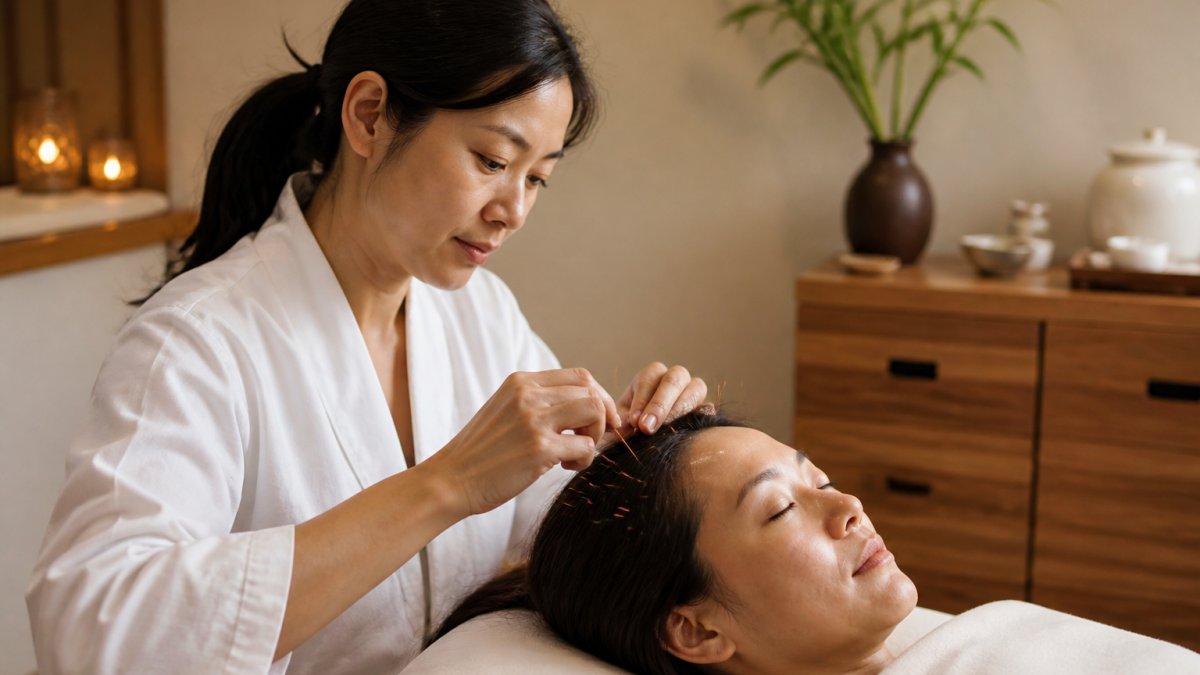
Traditional Chinese Medicine views hair loss through energy flow and organ balance: hair health depends on strong kidney essence (jing), adequate blood circulation, and balanced liver function. Scalp acupuncture, fine needles placed at specific points on the head, aims to improve microcirculation to hair follicles, reduce inflammation, and restore the hormonal signaling that supports hair growth.
Herbal formulations complement acupuncture: some tonify blood and kidney essence to support follicle health, others clear heat and inflammation from the scalp, and still others move stagnant energy that blocks nutrient delivery. Herbs such as ginseng, goji berry, fo-ti, and polygonum have been part of hair-health protocols in Chinese medicine for centuries, though modern practitioners increasingly combine them with clinical trichology insights.
Moxibustion, using heat from burning mugwort over acupuncture points, can enhance treatment by warming the scalp and improving circulation. Gua sha (scraping the scalp with a smooth tool) and scalp massage further support blood flow and lymphatic drainage. The principle is consistent: restore circulation and rebalance the body's systems so follicles receive the oxygen, nutrients, and hormonal signals they need to grow.
Natural Treatments for Hair Loss and Scalp Health
Nutritional Support and Supplements
Hair follicles demand consistent nutrients. Iron deficiency is one of the most common nutritional triggers of hair loss in women, yet many standard exams miss borderline cases. Zinc, essential for follicle protein synthesis and immune regulation, often runs low in women with inflammatory scalp conditions. B12 and folate support cell division in the follicle matrix, and vitamin D deficiency correlates with several forms of alopecia.
Rather than taking random supplements, an integrative approach identifies your specific gaps through testing, then targets those deficiencies with appropriate dosing and form. Bioavailable forms matter: iron as ferrous bisglycinate absorbs better than ferrous sulfate. Zinc as picolinate or citrate outperforms oxide. Methylated B vitamins work better for people with certain genetic variations.
Start Your Hair & Scalp Healing Journey →
Some practitioners also recommend targeted protocols: amino acids like lysine and methionine support keratin formation, silica strengthens hair structure, collagen peptides provide building blocks for hair matrix proteins, and adaptogens like rhodiola and ashwagandha help regulate stress-driven cortisol elevation that suppresses growth. Evidence for individual supplements varies, but a personalized combination addressing your specific deficiencies and triggers tends to outperform generic multivitamins.
Topical and In-Spa Treatments
Scalp health directly influences follicle function. Treatments that restore the scalp microbiome, the balance of beneficial bacteria and fungi, reduce inflammation and create an environment where hair can thrive. Specialized scalp therapies exfoliate dead skin, unclog follicles, and deliver targeted actives directly to the follicle base.
Minoxidil (Rogaine) remains an evidence-supported topical option for women experiencing hair shedding or thinning. It works by extending the growth phase of the hair cycle and improving blood flow to follicles. Results typically emerge after 4-6 months of consistent use, and discontinuing it reverses gains, making it a long-term commitment rather than a quick fix.
In-spa treatments like scalp massages, herbal masks, and specialized serums complement at-home care; professional-grade ingredients such as peptides, plant extracts, or caffeine penetrate more effectively under controlled conditions. The goal is twofold: reduce inflammation and conditions like dandruff or seborrheic dermatitis that impair follicle function, and actively nourish follicles with growth-promoting compounds.
When to Seek Dermatology Care or Professional Evaluation
Some hair loss requires specialist input. Sudden bald patches, rapid shedding over weeks, or loss accompanied by scalp pain, redness, or discharge warrants dermatologist evaluation to rule out alopecia areata, fungal infection, or other conditions requiring specific medical treatment.
If you've tried natural approaches for 3-4 months without improvement, professional evaluation helps clarify whether your root cause has been correctly identified. A dermatologist can perform a pull test or scalp biopsy if needed, and prescribe medications like finasteride (Propecia) if androgenetic alopecia is confirmed. Regenerative treatments, platelet-rich plasma (PRP) injections or stem cell therapies, require medical oversight and are best pursued through qualified practitioners.
The integrative and conventional approaches need not conflict. Many women benefit from combining acupuncture and nutritional support with dermatology-prescribed treatments. The key is ensuring all practitioners communicate about your overall plan so treatments complement rather than contradict each other.
What to Expect: Realistic Timelines and Outcomes
Hair growth operates on a slow timeline: the human hair cycle spans 2-7 years for growth, followed by shedding phases, and new hairs take months to become visible. Realistic expectations help you stay committed long enough to see results.
Most women notice stabilization of shedding within 4-8 weeks of starting an integrative protocol, fewer hairs in the shower drain or on the pillow. Visible regrowth typically requires 3-6 months.
The goal isn't always full reversal. For some women, stopping further shedding and stabilizing density is success; for others, active regrowth becomes possible once root causes are addressed.
Hair loss feels personal because it is, it affects how you see yourself. An integrative approach honors that by investigating what's actually driving your loss rather than applying a generic protocol.
Sophiatrichoholistic Hair Spa LLC specializes in this personalized, root-cause approach. We offer both in-spa treatments and home hair growth solutions designed specifically for women aged 18 to 65 dealing with alopecia, thinning, scalp inflammation, or chronic conditions like seborrheic dermatitis and psoriasis.
Learn more about integrative approaches to hair health and explore how addressing root causes differs from conventional dermatology alone.
Frequently Asked Questions
What is integrative medicine for hair loss, and how does it differ from conventional dermatology?
Integrative medicine for hair loss combines conventional clinical assessment with Traditional Chinese Medicine, functional nutrition, and holistic lifestyle evaluation. Unlike conventional dermatology, which typically treats symptoms with topical minoxidil or oral finasteride, integrative medicine seeks to identify and address underlying triggers such as hormonal imbalance, nutritional deficiencies, inflammation, and scalp microbiome disruption. It treats the person as a whole system rather than focusing only on the hair follicle.
What are the main causes of hair loss in women that integrative medicine addresses?
Integrative medicine evaluates multiple causes: hormonal imbalances (postpartum, thyroid dysfunction, androgen sensitivity), nutritional deficiencies (iron, zinc, B vitamins), chronic inflammation and oxidative stress, scalp microbiome disruption, blood flow restriction to the scalp, stress and nervous system dysregulation, and medical history factors. By identifying which causes apply to you, practitioners can tailor treatment to address your specific triggers rather than applying a one-size-fits-all approach.
How do hair loss blood tests help guide integrative treatment?
Hair loss blood tests measure markers that integrative practitioners use to identify root causes: ferritin and iron levels (iron-deficiency anemia), thyroid function (TSH, free T3, free T4), vitamin D and B12, zinc, and hormone levels (estrogen, progesterone, testosterone, DHEA). These results guide supplementation, dietary changes, and whether referral to an endocrinologist or other specialist is needed. Testing creates a baseline to track whether interventions are working.
Is there clinical evidence that Chinese medicine for hair growth actually works?
Traditional Chinese Medicine for hair growth includes acupuncture, herbal formulations, and scalp treatments that have been used for centuries. While rigorous clinical trials are limited, some research supports acupuncture for improving blood flow and reducing inflammation. The evidence quality is lower than for minoxidil or finasteride, so integrative practitioners typically combine TCM with clinically validated treatments and diagnostic testing. Results vary by individual and underlying cause.
What natural treatments for hair loss are safe, and which lack evidence?
Natural treatments with some research support include biotin, iron supplementation (if deficient), saw palmetto, pumpkin seed oil, and caffeine-based topicals. Herbal remedies like ginseng and ashwagandha may reduce stress and inflammation. However, 'natural' does not mean safe or effective for everyone; some supplements interact with medications or cause side effects. Integrative practitioners assess your medical history and test results before recommending supplements, and they monitor your response over time rather than making promises of permanent cure.