 ultimate-guide
Holistic Hair Restoration Cost 2026: Complete Pricing Guide
Table of Contents
- What Drives Holistic Hair Restoration Cost in 2026
- Holistic Scalp Treatment Cost: Services and Pricing Breakdown
- Non-Surgical Hair Loss Solutions 2026: Costs and Comparisons
- How to Find a Clinical Trichologist Near Me: What to Expect
- Holistic Hair Restoration vs. Surgical Hair Transplants: Cost and Value
- Hidden Costs: Recovery, Maintenance, and Travel
- Conclusion: Making a Cost-Effective Choice for Your Hair Health
- Frequently Asked Questions
Last Updated: September 17, 2026
What Drives Holistic Hair Restoration Cost in 2026
Holistic hair restoration cost in 2026 reflects a shift toward root-cause care: consultations, lab work, Traditional Chinese Medicine protocols, and clinical trichology assessments all factor into the total, not just a single procedure.
Several factors move the number up or down:
- Consultation depth: A clinical trichologist who examines scalp health, blood markers, and hormone balance spends more time than a quick visual check.
- Treatment type: Acupuncture, herbal medicine, platelet-rich plasma, and laser therapy carry different costs per session.
- Session frequency: Weekly intensive phases cost more upfront than maintenance schedules.
- Hair density and donor area condition: Women with advanced thinning need longer protocols.
Holistic Scalp Treatment Cost: Services and Pricing Breakdown
Holistic scalp treatment cost depends on which services your plan combines, and providers typically quote per session or per phase rather than one flat fee. A typical plan might include a trichology consultation, scalp microbiome assessment, acupuncture, and home care.
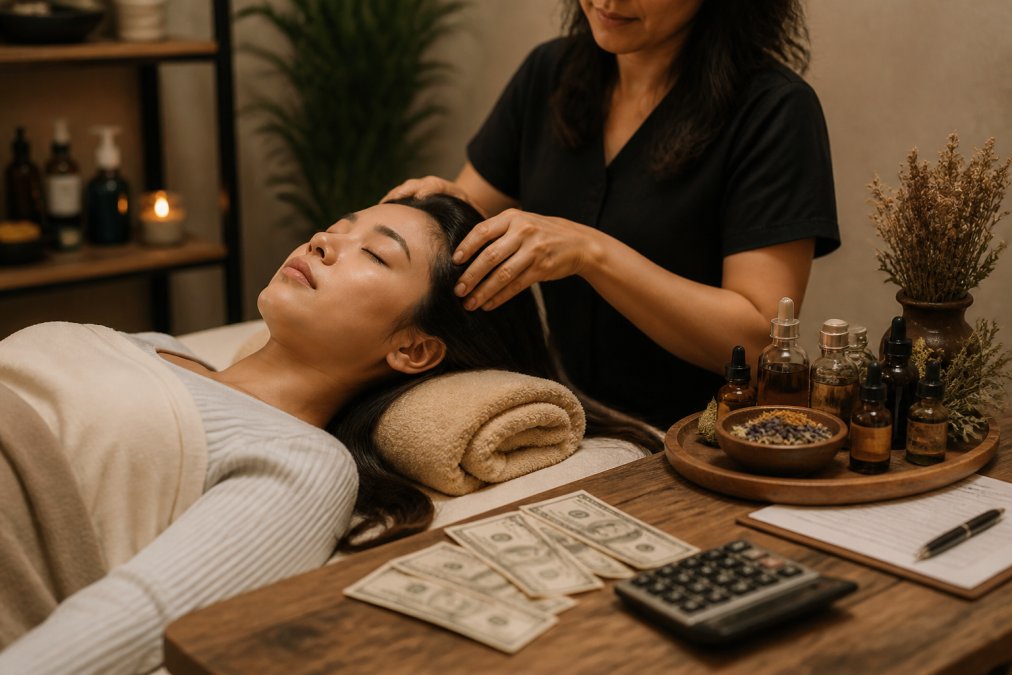
Here is how the components usually break down:
| Service Component | What It Addresses | Billing Basis |
|---|---|---|
| Initial trichology consultation | Scalp health, hair density, loss progression | One-time fee |
| Acupuncture sessions | Hormone balance, circulation, inflammation | Per session |
| Herbal and TCM protocols | Internal balance, scalp microbiome | Per phase |
| Topical and home care | Maintenance between visits | Per product cycle |
| Progress reassessment | Adjusting the plan as results appear | Periodic fee |
Non-Surgical Hair Loss Solutions 2026: Costs and Comparisons
Non-surgical hair loss solutions in 2026 span a wide price range, and the cheapest option is rarely the most effective for chronic conditions. What most comparison tables leave out is the cadence, how often you pay, for how long, and what happens when you stop. That cadence, not the sticker price, determines your real spend.
| Solution | Mechanism | Typical Cadence | What Drives the Total | Best For | Limitations |
|---|---|---|---|---|---|
| Topical minoxidil (2% or 5%) | Vasodilation and prolonged anagen phase | Daily, indefinitely | Bottle size, generic vs. brand, subscription vs. retail | Early thinning, maintenance | Shedding phase in first weeks; results reverse if stopped |
| Oral minoxidil (low-dose) | Systemic vasodilation | Daily, prescription | Office visits, monitoring | Patients who can't tolerate topicals | Off-label use; requires physician oversight |
| Finasteride | 5-alpha-reductase inhibition (DHT reduction) | Daily, prescription | Generic vs. brand, telehealth vs. in-person | Pattern hair loss in appropriate candidates | Not appropriate for women of childbearing potential; sexual side-effect reports |
| Platelet-rich plasma (PRP) | Growth-factor delivery via injections | Series of 3-4 sessions, then maintenance every 3-6 months | Number of sessions, whether micro-needling is added, provider specialty | Density improvement, adjunct to other therapies | Multiple sessions needed; results vary widely by protocol |
| Low-level laser therapy (LLT) | Photobiomodulation of follicle cells | Daily or every other day | Device purchase (cap or comb) vs. in-office per-session | Mild stimulation, home convenience | Slow, incremental results; device quality varies enormously |
| Microneedling (with or without topicals) | Controlled micro-injury to stimulate repair | Every 2-4 weeks | Per-session fee, whether PRP is combined | Enhancing topical absorption | Not for active scalp infection or certain skin conditions |
| Clinical trichology plus TCM | Root-cause assessment, herbal protocols, acupuncture | Phased plan, then maintenance | Diagnostic depth, session count, home protocol | Chronic scalp conditions, hormonal shedding | Requires commitment and consistency |
The 2026 lifecycle cost angle most guides skip
A single product's monthly price tells you almost nothing. What matters is the total cost of the treatment arc, the months you spend on it, the add-ons layered in, and the cost of stopping:
- Months 1-3 (trial phase): one or two products, low monthly outlay, high uncertainty. Many quit here because shedding can worsen before it improves.
- Months 4-12 (stacking phase): a topical, an oral, a supplement, and a device get added. Monthly spend often doubles or triples without a jump in results, because the root cause was never identified.
- Year 2+ (maintenance phase): whatever worked must continue indefinitely. Compare the annualized cost, not the introductory price.
How to Find a Clinical Trichologist Near Me: What to Expect
- Certification and licensure: Look for recognized trichology credentials and, where relevant, medical or acupuncture licensure.
- Diagnostic process: Ask whether they assess scalp microbiome, inflammation, and hormone-related factors.
- Personalization: A provider who offers the same protocol to every client is not practicing holistic care.
- Progress tracking: You should know how and when results will be measured.
- Scope of practice: Confirm they work within their training and refer out when a medical issue needs a physician.
The American Academy of Dermatology's page on hair loss in women notes that women's hair loss often has multiple contributing causes, which supports choosing a provider who evaluates the whole picture rather than one symptom.
Holistic Hair Restoration vs. Surgical Hair Transplants: Cost and Value
Holistic hair restoration and surgical transplants solve different problems, and comparing them on price alone leads to bad decisions. Surgery addresses where hair no longer grows by redistributing follicles. Holistic care addresses why hair is thinning.
How surgical pricing actually works
Transplant pricing in 2026 is usually quoted one of three ways, and the format matters as much as the number:
Start Your Hair & Scalp Healing Journey →
- Per graft: the most common. The total depends on how many grafts the surgeon estimates you need, which is a function of the recipient area and the density target.
- Per session or per day: common for larger cases. A session may run several hours and cover a defined graft range.
- Flat package: less common, and usually the one to scrutinize most closely, because "unlimited grafts" packages tend to cap the session length rather than the graft count.
The cost pattern difference
Holistic care spreads cost across a phased plan: lower per session, but requiring consistency over months. Surgery is the opposite, a large upfront expense tied to graft count, technique, and surgeon's fees, followed by smaller maintenance costs and, sometimes, a revision.
| Factor | Holistic Restoration | Surgical Transplant |
|---|---|---|
| Primary goal | Treat root causes, restore scalp health | Redistribute existing follicles |
| Cost pattern | Phased, per-session, lower per visit | Large one-time procedure, priced per graft or per session |
| Technique variables | Protocol mix, session count | FUE vs. FUT, graft count, surgeon experience |
| Downtime | None to minimal | Recovery period required; donor and recipient area healing |
| Best for | Active thinning, scalp conditions, early loss | Stable loss with adequate donor area |
| Ongoing needs | Maintenance protocols | Possible revision surgery later |
| Reversibility | Plan can be adjusted or paused | Grafts are permanent; poor results are hard to undo |
The travel and revision math competitors gloss over
- Travel and lodging for the procedure and any follow-up window.
- Time off work, which for a large session can be a week or more.
- Revision risk. If the result is unsatisfactory or grafts don't take, a revision far from home means paying for travel twice.
- Continuity of care. Post-operative questions are easier to resolve with a surgeon you can see in person.
For many women, the two are not competitors. A surgeon may require a healthy scalp before operating, and holistic care often gets the scalp there. If hair loss is still progressing, surgery alone will not stop it, you can transplant into an area that continues to thin around the grafts.
Hidden Costs: Recovery, Maintenance, and Travel
The costs most pricing guides ignore show up after treatment starts. Recovery expenses, ongoing maintenance, and travel add up, and budgeting for them upfront prevents abandoned plans.
Conclusion: Making a Cost-Effective Choice for Your Hair Health
The hardest part of treating hair loss is not finding a cheaper option. It is committing to a plan long enough to see whether it works while your hair loss progression continues.
Frequently Asked Questions
How does holistic hair restoration differ from surgical hair transplants?
Holistic hair restoration addresses root causes like inflammation, hormonal imbalances, and scalp health through non-surgical methods such as acupuncture, herbal medicine, and nutritional counseling. Surgical transplants move hair follicles but don't treat underlying conditions. Holistic approaches aim for sustainable regeneration and often cost less upfront, though results take longer. A clinical trichologist can determine which approach suits your needs.
What factors influence the cost of holistic scalp and hair treatments?
Costs vary based on consultation fees, treatment frequency, provider expertise, and geographic location. The complexity of your condition, such as chronic scalp psoriasis versus mild thinning, also affects the number of sessions required. Always request a personalized quote after an initial assessment.
Is holistic hair restoration covered by health insurance?
Most health insurance plans in the U.S. do not cover holistic hair restoration because it's considered cosmetic or alternative medicine. However, some flexible spending accounts (FSAs) or health savings accounts (HSAs) may allow reimbursement if a physician diagnoses a medical condition like alopecia. Check with your insurance provider and a tax advisor to understand your specific coverage.
How long does it take to see results from holistic hair restoration?
Initial improvements in scalp health, such as reduced inflammation or oiliness, may appear within 4-6 weeks. Visible hair regrowth typically takes 3-6 months, as hair grows slowly. Consistency with in-spa treatments and home care is key. A clinical trichologist will track progress and adjust your plan. Remember, holistic restoration focuses on long-term sustainability, not quick fixes.