 listicle
Best Scalp Care for Thinning Hair: 2026 Guide
Table of Contents
- Quick Comparison: Best Scalp Care for Thinning Hair
- How We Evaluated These Scalp Care Options
- 1. Sophiatrichoholistic Hair Spa LLC: Holistic Root-Cause Care
- 2. Rogaine (Minoxidil): FDA-Approved Topical Treatment
- 3. Vegamour GRO+ Advanced Hair Serum: Plant-Based Density Support
- 4. The Ordinary Multi-Peptide Serum: Budget Peptide Option
- 5. Briogeo Scalp Revival Treatment: Detox for Buildup and Irritation
- 6. Nioxin System Kits: Multi-Step Scalp and Hair System
- Frequently Asked Questions
Last Updated: September 22, 2026
Quick Comparison: Best Scalp Care for Thinning Hair
Finding the best scalp care for thinning hair starts with one question: are you treating the symptom or the cause? Most products address surface volume. Fewer address the follicle itself. This guide from Sophiatrichoholistic Hair Spa LLC compares six options, from FDA-approved topicals to holistic root-cause care, so you can match the right approach to your type of hair thinning.
| Product | Starting Price | Approach | Best For |
|---|---|---|---|
| Sophiatrichoholistic Hair Spa LLC | Varies by plan | Holistic, root-cause | Women with chronic scalp conditions |
| Rogaine (Minoxidil) | $25.00 | FDA-approved topical | Hereditary thinning |
| Vegamour GRO+ Serum | $74.00 | Plant-based serum | Clean-ingredient preference |
| The Ordinary Multi-Peptide | $21.70 | Budget peptide serum | Cost-conscious users |
| Briogeo Scalp Revival | $32.00 | Detox treatment | Buildup and irritation |
| Nioxin System Kits | $45.00 | Multi-step system | Full routine coverage |
How We Evaluated These Scalp Care Options
Every option here was judged on four criteria: how it addresses follicle miniaturization, whether it supports scalp health rather than just hair appearance, ingredient transparency, and realistic expectations for the hair regrowth cycle.
We weighted root-cause treatment higher than cosmetic volume. A shampoo that makes hair look thicker for a day is not the same as a treatment that supports the anagen phase. The American Academy of Dermatology's guidance on hair loss draws a similar distinction between treating shedding and masking it.
Options that only coat the hair shaft scored lower than those that reach the scalp. Products requiring indefinite use without addressing why thinning started also lost points.
1. Sophiatrichoholistic Hair Spa LLC: Holistic Root-Cause Care
Sophiatrichoholistic Hair Spa LLC is a holistic hair and scalp practice built exclusively for women ages 18 to 65, combining Traditional Chinese Medicine with clinical trichology. That combination is the point: it treats thinning as a whole-body signal, not an isolated scalp problem.
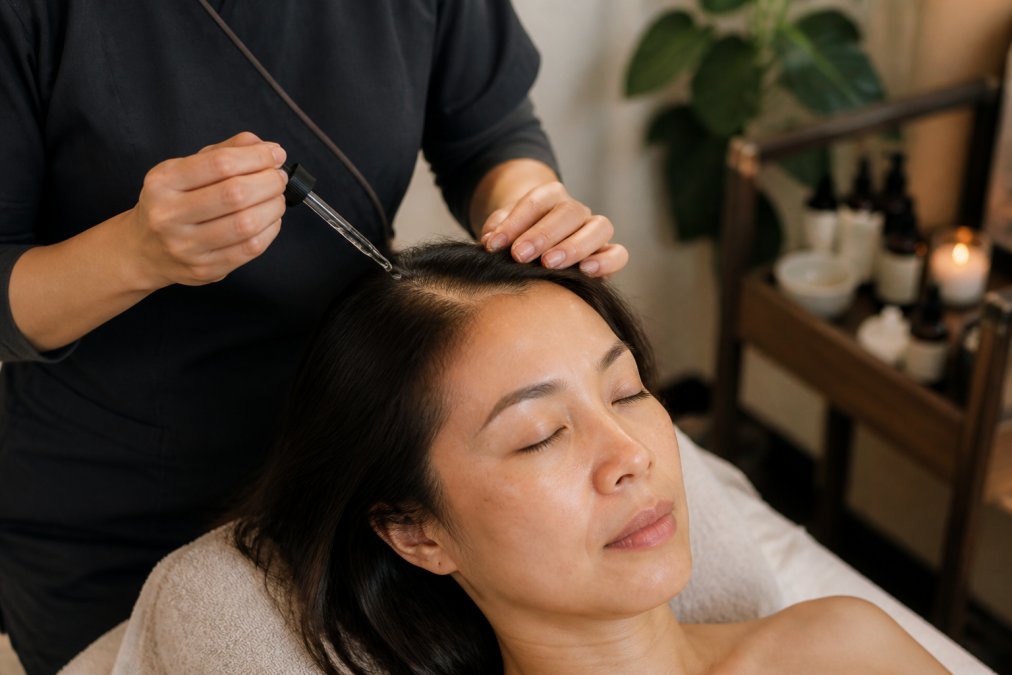
The practice targets the drivers conventional products ignore: scalp inflammation, hormone balance, and a disrupted scalp microbiome. Its services address dandruff, seborrheic dermatitis, and psoriasis alongside general thinning, and it offers both in-spa treatments and home hair growth solutions.
For women whose thinning stems from postpartum shedding, chronic scalp conditions, or inflammation that has not responded to standard dermatological care, this is the most complete option on the list. Pricing depends on your personalized plan, so check the website for current details.
2. Rogaine (Minoxidil): FDA-Approved Topical Treatment
Rogaine is the best-known minoxidil option and the only over-the-counter topical approved by the FDA for hereditary hair loss. It is available in two strengths, 2% (marketed primarily to women) and 5% (marketed primarily to men), as a liquid or a foam, applied directly to a dry scalp twice daily for the 2% solution or once daily for the 5% foam. Pricing starts around $25.00 for a one-month supply, though multi-month bundles lower the per-month cost.
How minoxidil actually works
Minoxidil is a vasodilator. Applied to the scalp, it widens the small blood vessels feeding the hair follicle, which increases delivery of oxygen and nutrients to the dermal papilla, the cluster of cells at the base of the follicle that governs growth. The downstream effect is a longer anagen (growth) phase and a shorter telogen (resting) phase, so more follicles are actively producing hair at any given time. It does not create new follicles. It recruits existing ones back into production.
That mechanism explains both the results and the limits. Minoxidil manages androgenetic alopecia; it does not resolve it. Follicles that have fully miniaturized into scar tissue will not respond, which is why early intervention matters.
The shedding phase nobody warns you about
Most users notice increased shedding in weeks two through six. This is not treatment failure, it is the old telogen hairs being pushed out as follicles re-enter anagen. The shed typically resolves by week eight, and visible density change appears between months three and six. Stopping during the shed phase is the single most common reason people conclude minoxidil "didn't work."
Ingredient interactions and contraindications
This is where most guides stop short. Minoxidil does not layer cleanly with everything else on your shelf:
- Retinoids and exfoliating acids (AHA/BHA). These increase scalp permeability, which can amplify minoxidil absorption and irritation. Space them at least 12 hours apart, or use them on non-minoxidil days.
- Other vasodilators or stimulant oils. Peppermint, rosemary, and caffeine serums can compound the tingling and redness minoxidil already causes. Introduce one at a time.
- Corticosteroids or prescription topicals. Ask a dermatologist before combining; some formulations reduce minoxidil's efficacy.
- Pregnancy and breastfeeding. Minoxidil is not recommended. This is a hard stop, not a caution.
- Scalp conditions. Active seborrheic dermatitis, psoriasis, or broken skin can worsen with the propylene glycol in liquid formulations. The foam version is often better tolerated. (Source: guidance on hair loss)
Where minoxidil falls short
Minoxidil does little for thinning driven by inflammation, thyroid dysfunction, nutritional deficiency, or postpartum shedding, because those causes sit upstream of the follicle. If your shedding started after a pregnancy, an illness, or a period of high stress, minoxidil may mask the symptom while the underlying driver continues. Pairing it with a scalp-health routine that addresses inflammation and barrier function tends to produce better outcomes than minoxidil alone.
Start Your Hair & Scalp Healing Journey →
3. Vegamour GRO+ Advanced Hair Serum: Plant-Based Density Support
Vegamour's GRO+ serum is the pick for anyone who wants plant-based ingredients without sacrificing a targeted formula. It uses phyto-actives to support density, applies as a lightweight, non-greasy serum, and skips harsh chemicals.
At $74.00 it sits at the premium end. The trade-off is evidence: plant-based serums support scalp conditions and hair appearance, but they do not carry the same regulatory approval as minoxidil. For early thinning or as a complement to in-spa care, it is a reasonable choice.
4. The Ordinary Multi-Peptide Serum: Budget Peptide Option
Peptide-rich formulas have become a popular middle path, and The Ordinary's Multi-Peptide Serum is the most affordable entry at $21.70. It blends peptides with plant extracts in a leave-in formula that supports scalp circulation without a sticky finish.
What most guides miss is that peptides support the scalp environment; they are not DHT blockers. If your thinning is hormonal, this serum alone will not be enough. Used daily alongside a proper scalp routine, though, it is a low-risk starting point.
5. Briogeo Scalp Revival Treatment: Detox for Buildup and Irritation
Briogeo's Charcoal + Tea Tree treatment targets a specific problem: a scalp clogged by sebum, product buildup, and dead skin. Binchotan charcoal draws out impurities, tea tree oil soothes itch, and peppermint stimulates circulation. At $32.00, it is a solid scalp detoxification step.
Be clear about what it does. This is a clarifying treatment, not a follicle stimulant. If your thinning traces back to irritation and buildup, it can help reset the scalp barrier. If the cause is hormonal, it will not move the needle on its own.
6. Nioxin System Kits: Multi-Step Scalp and Hair System
Nioxin takes a systematic approach, bundling a cleanser, conditioner, and scalp treatment tailored to your thinning level and hair type. The kits remove follicle-clogging sebum and balance moisture, and they are widely recognized in salons.
Starting at $45.00, the appeal is structure: you get a complete routine rather than a single product. The drawback is the routine itself. Three steps every wash day is a real commitment, and consistency matters more than any single ingredient here.
Frequently Asked Questions
What are the big 3 treatments for thinning hair?
The 'big 3' usually refers to minoxidil (topical), finasteride (oral, typically prescribed for men), and ketoconazole shampoo. For women, finasteride is often not recommended due to side effects. Minoxidil remains the most common FDA-approved topical option. Many women also explore natural hair regrowth for women through holistic scalp care, which addresses inflammation, circulation, and follicle health without prescription drugs.
How does scalp inflammation contribute to hair loss?
Scalp inflammation can disrupt the hair regrowth cycle, pushing follicles into the telogen (resting) phase and causing shedding. Conditions like seborrheic dermatitis and psoriasis create chronic inflammation that may lead to follicle miniaturization over time. Addressing scalp inflammation and hair loss together, through gentle cleansing, anti-inflammatory ingredients, and professional care, helps create an environment where follicles can function normally.
Are there natural scalp care ingredients that support hair density?
Several plant-based ingredients have shown promise for scalp health. Peptides, caffeine, rosemary oil, and ginger root may support scalp circulation and follicle stimulation. Ingredients like tea tree oil and charcoal help with sebum regulation and scalp detoxification. For those wondering how to stimulate hair follicles naturally, combining gentle exfoliation, scalp massage, and peptide-rich formulas can improve the scalp environment without harsh chemicals.
When should you see a professional for thinning hair?
If you notice sudden or patchy shedding, scalp pain, or thinning that does not improve with over-the-counter products after three to six months, a professional evaluation is warranted. A trichologist or dermatologist can identify whether the cause is hormonal, inflammatory, or related to a medical condition. Early intervention often leads to better outcomes, so do not wait if hair loss is progressing.
What can women aged 18-65 do to manage scalp thinning?
Start with a scalp-focused routine: use a gentle clarifying shampoo to remove buildup, apply a leave-in treatment or serum with peptides or minoxidil, and avoid tight hairstyles that cause breakage. Address underlying factors like stress, diet, and hormonal changes. For chronic conditions such as psoriasis or seborrheic dermatitis, a holistic approach that combines clinical trichology with Traditional Chinese Medicine may help restore balance and support sustainable hair regeneration.